
How to Search Mitchell County Court Records
Mitchell County court records moved into North Carolina's eCourts environment on July 21, 2025 as part of Track 9. Public online access now starts with the NC eCourts Portal, which includes Smart Search for case information, Search Hearings for court dates, online payment tools for eligible matters, and NC Judgment Search. The Portal is useful for many current case details, but it is not the only access channel. The Clerk of Superior Court still handles paper files, certified copies, background searches through the clerk, public terminals, estates, and older documents that were not fully online at conversion.
A strong Mitchell County Court records search uses the county filter first. Name searches can return statewide matches, and the Portal instructions allow record-number searches, person names in Last, First Middle Suffix format, business-name searches, and wildcard searches. If the online result does not show the document needed, contact the Mitchell County Courthouse clerk counter for the local paper file or a certified copy.
- Open the NC eCourts Portal and choose Smart Search for case records or Search Hearings for court dates.
- Enter a record number when available, or enter a name in the format shown by the Portal.
- Use Advanced Filtering Options and select Mitchell County to reduce false statewide matches.
- Review the case status, filing date, hearing entries, payments, and document availability shown for that case.
- Ask the Clerk of Superior Court for paper documents, certified copies, or background searches that should not rely only on Portal results.
The Judicial Branch eCourts announcement identified Mitchell County as a Track 9 county. The Track 9 transition notice also explains why some older paper records and migration-period filings may require clerk follow-up instead of a simple online lookup.
The official Mitchell County Judicial Branch page is the county entry point for court services, local rules, forms, payments, jury service, and courthouse links. The image below is sourced from that county court page and helps identify the official Judicial Branch location used for Mitchell County court records.
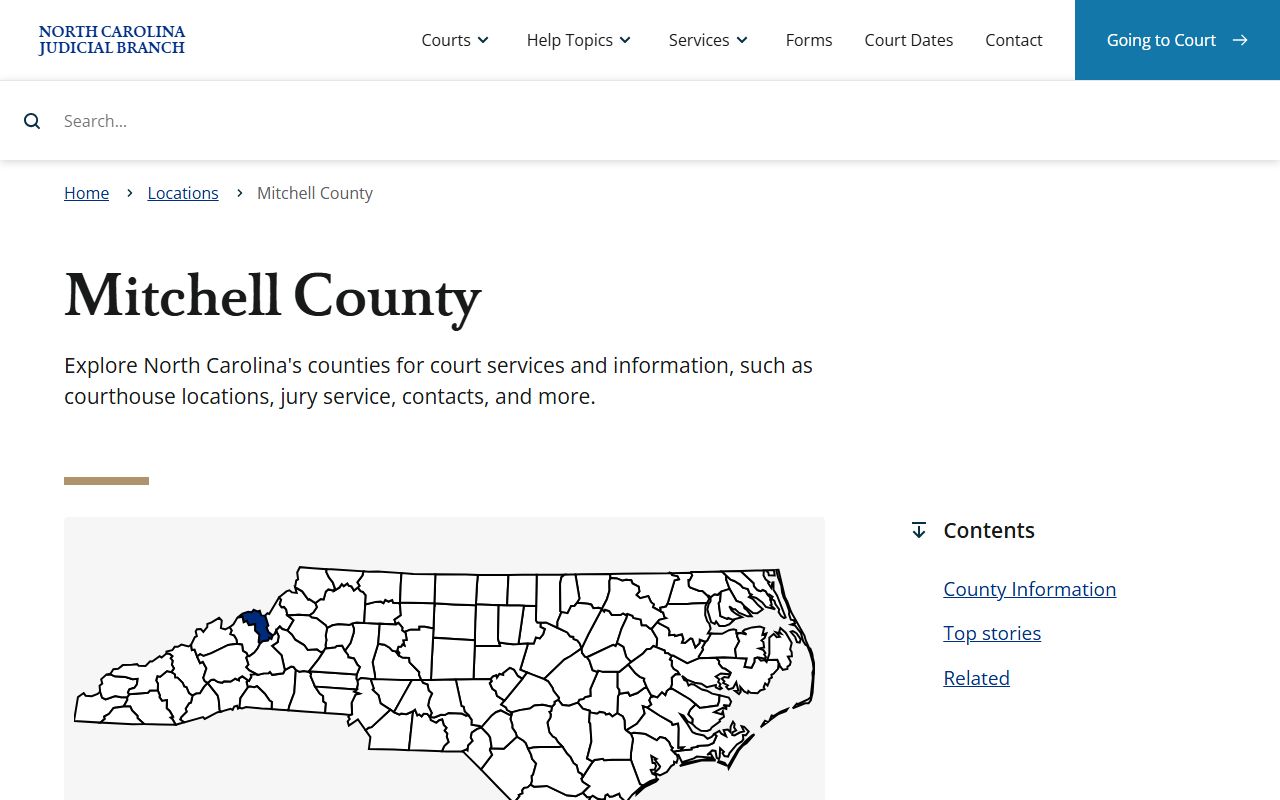
Use the Judicial Branch page for county court links, then use Portal or the clerk depending on whether the record is electronic, paper, certified, or restricted.
The Mitchell County Judicial System
Mitchell County does not operate a separate county court system. North Carolina uses one statewide General Court of Justice with appellate courts, Superior Court, District Court, and magistrates. Superior Court is the main trial court for felony criminal cases, civil cases over $25,000, and appeals from District Court. District Court handles misdemeanors, infractions, traffic matters, juvenile matters, domestic relations, small civil cases, and magistrate matters. The Clerk of Superior Court is the unified local clerk for both trial divisions, special proceedings, estates, and court records.
Mitchell County is in Prosecutorial District 35, Superior Court District 35, and District Court District 35 with Avery, Madison, Watauga, and Yancey counties. Judge Rebecca Eggers-Gryder was appointed Chief District Court Judge for District 35 effective January 1, 2025. The District Attorney for Prosecutorial District 35 is Seth Banks, with the main office in Boone and a Mitchell courthouse contact through the local directory.
Case flow: Magistrate or District Court › Superior Court when required › North Carolina Court of Appeals › North Carolina Supreme Court.
| Court | Jurisdiction | Case Types |
|---|---|---|
| Superior Court District 35 | Primary trial court for higher-level matters | Felonies, civil cases over $25,000, appeals from District Court, some special proceedings |
| District Court District 35 | Lower trial division in the county seat | Misdemeanors, infractions, traffic, domestic, juvenile, small civil cases, magistrate matters |
| Magistrates | Limited judicial officers within District Court | Initial appearances, some warrants, small claims, summary ejectment, limited criminal process |
The official North Carolina court structure overview explains the statewide hierarchy that controls Mitchell County records. This matters because traffic, misdemeanor, felony, estate, and civil records are not split among local city courts or justice-of-the-peace courts.
The image from the Judicial Branch court-structure source shows the official statewide court framework that Mitchell County follows.
That structure is the reason most local court record searches route through Superior Court, District Court, magistrates, the Clerk of Superior Court, and the NC eCourts Portal.
Mitchell County Courthouses
The main state court facility is the Mitchell County Courthouse at 328 Longview Drive in Bakersville. The Judicial Branch lists the same address for visits and mail, with posted hours Monday through Friday, 8:30 a.m. to 5:00 p.m. Superior Court, District Court, the Clerk of Superior Court, court filings, court payments, estates, paper files, and public court terminals all route through this courthouse. Marriage licenses, certified marriage copies, deed records, and many vital-record requests do not use the courthouse; those records go to the Register of Deeds at 26 Crimson Laurel Circle, Suite 4.
The official courthouse page is the source for the current address, hours, map, and main phone number. The Mitchell County contact directory adds the local court contacts for the clerk, judges, magistrates, district attorney, Guardian ad Litem, and court-related offices.
Mitchell County Courthouse
328 Longview Dr
Bakersville, NC 28705
(828) 688-5100
Monday-Friday, 8:30 a.m.-5:00 p.m.
Mitchell County Sheriff's Department
305 Baker Lane
Bakersville, NC 28705
(828) 688-3982
If no answer: (828) 688-9974
Mitchell County Register of Deeds
26 Crimson Laurel Circle, Suite 4
Bakersville, NC 28705
(828) 688-2139 ext. 1402
Monday-Friday, 8:00 a.m.-4:30 p.m.
The official courthouse image source confirms the public-facing court location for Mitchell County court records.
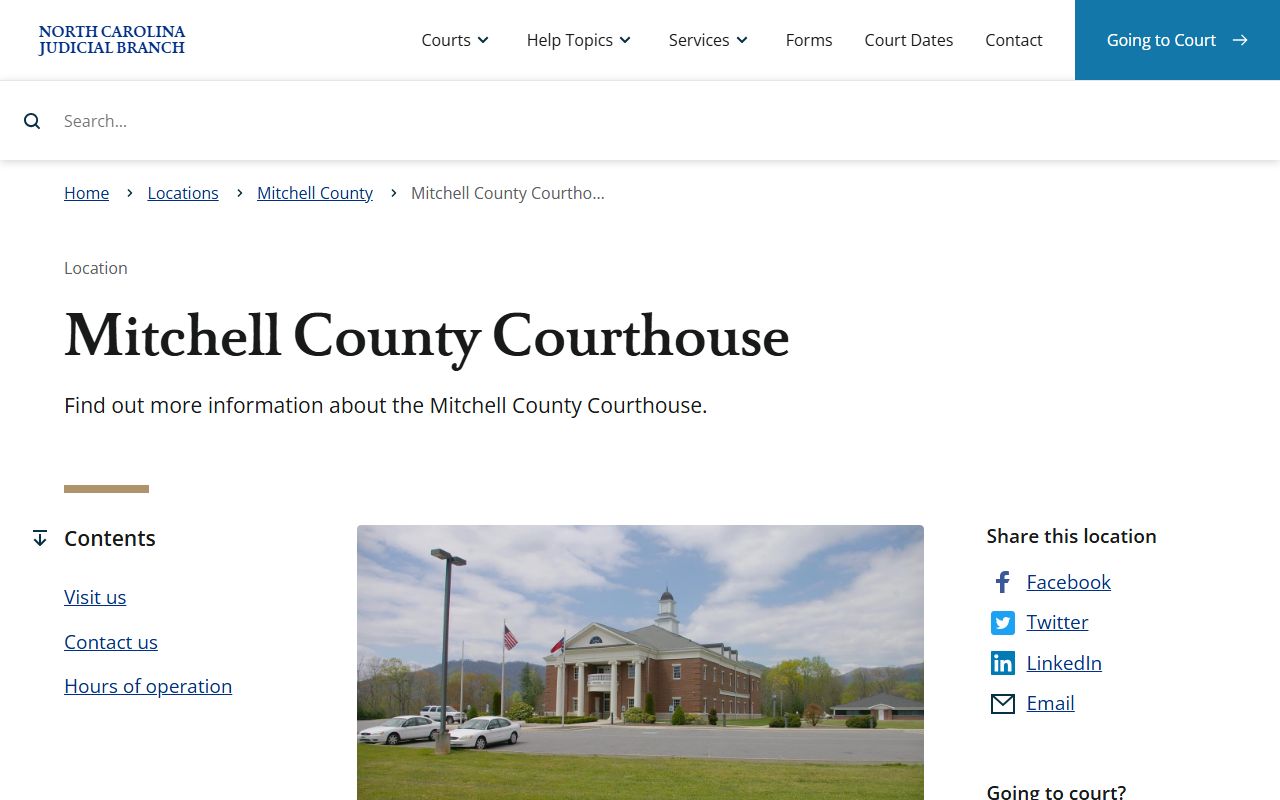
Use the courthouse for court files and hearings, and use the Register of Deeds for marriage certificates, deeds, and many local vital-record services.
Types of Court Records Available in Mitchell County
Mitchell County court records include civil, criminal, family, divorce, estate, traffic, judgment, and special-proceeding files. Superior Court records tend to involve felonies, higher-value civil disputes, and appeals from District Court. District Court records tend to involve misdemeanors, infractions, traffic citations, domestic cases, juvenile matters, and smaller civil cases. The Clerk of Superior Court keeps records for both divisions and acts as probate judge for estates and many guardianship matters.
The record type controls the best access path. A criminal case may show in Portal, but a background search through the county clerk is a separate process. A divorce judgment is a court record held by the clerk, while a divorce certificate may be requested through N.C. Vital Records. A marriage license is not a court record in Mitchell County, because the Register of Deeds issues and records it.
- Criminal records include charges, pleas, hearings, dispositions, sentences, bond terms, and court costs.
- Civil records include complaints, summonses, answers, motions, orders, judgments, and satisfaction entries.
- Family and divorce records include domestic District Court files and divorce judgments, with some sensitive records restricted.
- Estate records include wills, applications, inventories, accountings, letters, orders, and clerk hearings.
- Traffic records include citations, court dates, waiver/payment status, dispositions, fines, and license-related consequences.
What Mitchell County Court Records Show
Public case fields depend on case type, security limits, Portal availability, and whether a paper file predates eCourts. Typical Mitchell County court records may show the case number, county, division, case type, filing date, party names, attorney names, case status, hearing dates, docket entries, costs, judgments, and available documents. Criminal records may also show charge descriptions, statute references, bond or release conditions, arraignment, plea, disposition, sentence, probation, restitution, and payment status.
| Field | What It Shows |
|---|---|
| Case Number | The unique court record identifier assigned by the clerk or eCourts system. |
| Filing Date | The date the case or document was filed with the Clerk of Superior Court. |
| Parties | Names of defendants, plaintiffs, petitioners, respondents, businesses, or attorneys where public. |
| Charges / Cause | The criminal allegation, civil claim, citation, estate matter, or special proceeding type. |
| Disposition | The outcome, such as dismissed, guilty, not guilty, responsible, judgment entered, or closed. |
| Sentence / Judgment | Probation, fines, costs, restitution, civil judgment terms, orders, or other final action. |
Portal supports court records and documents for eCourts cases, but the research cautions against promising that every case has downloadable documents. For Track 9 cases that existed before the July 21, 2025 go-live, some paper documents remain available in paper form at the clerk's office.
Public Access Laws for Mitchell County Court Records
Mitchell County state court records are public unless a statute, court rule, or court order restricts them. The public can search many case records online, use public terminals in a clerk's office, or request paper files and copies from the Clerk of Superior Court in the county where the case was filed. The Judicial Branch also offers an administrative public-record request form, but that form is not the main path for local case files, divorce judgments, criminal background searches, or vital certificates.
Key Statutes:
N.C.G.S. Chapter 132 defines public records for North Carolina agencies.
N.C.G.S. 7A-109 requires clerks to keep records, files, dockets, and indexes open during regular office hours unless law restricts access.
N.C.G.S. 7B-3000 keeps juvenile records from ordinary public inspection.
The Judicial Branch public-record routing page explains when to contact the local clerk, another county office, or NCAOC. The NCAOC web form is useful for existing Judicial Branch administrative records, but court documents and case information stay with the clerk in the county where the case was filed.
The image below comes from the NCAOC public-record form source used in the research.
For most Mitchell County case files, the better first step is still Portal or the Clerk of Superior Court, not a broad statewide administrative request.
Records That Are Restricted or Confidential
Not every Mitchell County court record is open online or available at a public counter. Juvenile delinquency and undisciplined proceedings are confidential under North Carolina law. Adoption records, mental health commitments, sealed files, expunged criminal records, protected addresses, financial account numbers, Social Security numbers, and certain minor information may be withheld or redacted. Portal access and clerk-office access are public access tools, not a promise of full internet publication.
North Carolina uses the terms expunction and expungement for removal of eligible criminal records from ordinary public systems. A petition is usually filed in the county where the charge or conviction occurred. Dismissed charges and not-guilty findings are handled under N.C.G.S. 15A-146, while some nonviolent misdemeanors and felonies are addressed under N.C.G.S. 15A-145.5.
Specialty Courts in Mitchell County
Mitchell County's research surfaced two practical court initiatives rather than a long list of county-only specialty courts. First, Safe Babies Court began enrolling families in Mitchell County in summer 2024, along with New Hanover and Yancey counties. The statewide Safe Babies Court program focuses on child-welfare court cases and aims to reduce the time infants and toddlers spend in foster care before a safe permanent home is reached.
Second, North Carolina Adult Treatment Courts and recovery-court models may affect some repeat offenders with substance use, mental health, or co-occurring disorders, but the research did not find a Mitchell-specific adult treatment court page. Any person relying on eligibility should ask District 35 court staff or counsel. The largest court-access initiative affecting all Mitchell County records is eCourts, which replaced legacy public inquiry systems for Track 9 cases after July 21, 2025.
Mitchell County Sheriff and Jail
The Mitchell County Sheriff's Department is led by Sheriff Donald Street and is located at 305 Baker Lane in Bakersville. The county lists the office phone as (828) 688-3982 during office phone hours, with (828) 688-9974 if no one answers, and emergency calls routed to 911. The North Carolina Sheriffs' Association profile lists Mitchell County's jail as N/A, and the research did not find an official Mitchell County online jail roster or sheriff warrant portal.
That limit is important for Mitchell County inmate records and warrant records. Current custody routing should be checked with the Sheriff's Department, state prison/probation/parole status can be checked through the NC Department of Adult Correction offender search, and filed criminal court charges should be checked through Portal or the Clerk of Superior Court.
Marriage, Divorce, and Clerk of Superior Court acting as probate judge
Marriage, divorce, and estate records use different Mitchell County offices. The Register of Deeds issues marriage licenses and certified marriage certificates. The Clerk of Superior Court keeps divorce judgments in the county where the divorce was granted and handles estate files because North Carolina clerks act as probate judges. N.C. Vital Records may hold divorce certificates and some statewide vital-record copies, but it is not the same as the court file or the county marriage-license office.
For marriage and divorce records, start with the Register of Deeds for licenses and certificates and the clerk for divorce judgments. For estate and probate records, start with Portal, the public terminal, or the Clerk of Superior Court.
- Testator
- A person who made a will.
- Executor
- A person named to administer an estate when a will is accepted.
- Special proceeding
- A clerk-handled matter such as estate, foreclosure, guardianship, or certain property proceedings.
Mitchell County Court Records Fees
The research file gives exact Mitchell County payment methods for court payments and exact Register of Deeds fees for vital records and recorded documents. It does not provide a local clerk copy-fee schedule for every court document, so court-copy fees should be confirmed with the Clerk of Superior Court before requesting certified copies. In-person Mitchell County court payments may be made by cash, credit or debit card with processing fees, money order, or certified check. Personal checks are not accepted for those courthouse payments.
| Item | Amount |
|---|---|
| Marriage license | $60.00 |
| Certified vital record copy from Register of Deeds | $10.00 per copy |
| Uncertified vital record copy from Register of Deeds | $0.25 per copy |
| Register of Deeds certified document copy | $5.00 first page plus $2.00 each additional page |
| Mitchell County court payment methods | Cash, credit/debit plus processing fees, money order, certified check; no personal checks |
The official Mitchell County payment information page should be checked before paying a citation or court balance. The Register of Deeds fee schedule controls deed and local vital-record copy fees.
How to Interpret Mitchell County Court Records
A court record is not the same thing as an arrest record, a jail roster entry, or a driver record. A charge is an allegation filed after arrest, citation, indictment, or warrant. A conviction or responsible finding is an outcome. A disposition is the case result, such as dismissed, guilty, not guilty, responsible, or judgment entered. A docket is the chronological list of filings, hearings, and court actions. A judgment is the final enforceable court decision or order.
Mitchell County traffic records also need careful reading. The court traffic record shows the citation, court date, plea or waiver, disposition, fines, costs, and compliance. The state driver record is maintained by NCDMV and shows license status, reported convictions, points, and suspensions. A person may need both records for license restoration, insurance, or employment driving checks.
Accuracy and Record Limitations
Mitchell County's eCourts conversion created a clear online access point, but it did not erase older paper files or remove every need for clerk verification. Portal requires JavaScript and cookies, uses CAPTCHA challenges, and may require registration or elevated access for some material. Paper documents that existed on the Track 9 go-live date remained available at the clerk's office. Paper filings received during migration were file-stamped but entered and indexed later in Enterprise Justice.
Note: Confirm deadlines, court dates, warrants, and certified-copy needs with the originating office before relying on online records.
The Judicial Branch court-records help page explains how to obtain paper files and court documents. The image below comes from that official source.
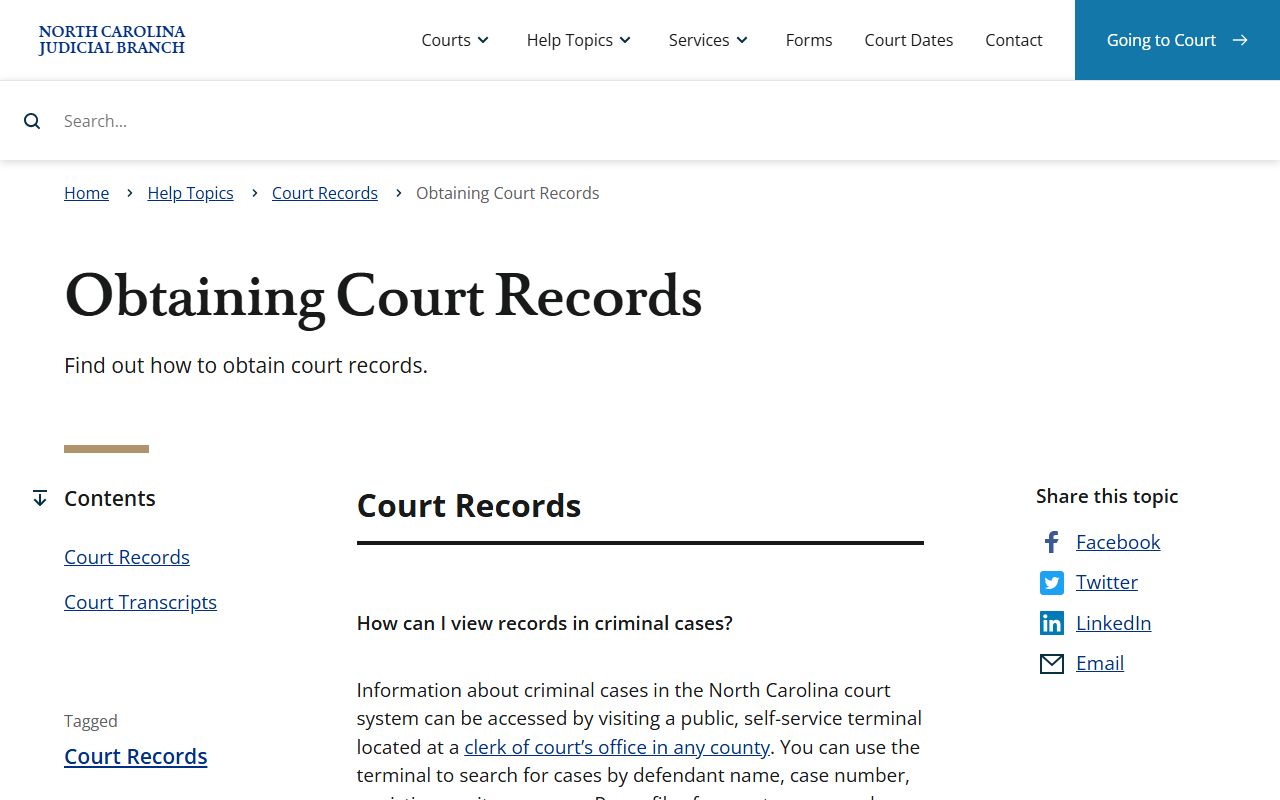
If an online record appears incomplete, the clerk's office in the filing county remains the record custodian for the court file.
History of Mitchell County Courts
Mitchell County is a small western North Carolina mountain county with Bakersville as the county seat. The current courthouse was constructed in 2003, according to a North Carolina Courts post, and sits above the historic courthouse built in 1908. The modern records point, however, is the current courthouse and the statewide General Court of Justice. North Carolina's court history matters because jurisdiction was made uniform statewide, older justice-of-the-peace and mayor courts were replaced by magistrates within District Court, and local court records now route through the state system rather than independent city courts.
The most recent local access milestone is the July 21, 2025 eCourts go-live. Before that date, legacy systems and paper workflows controlled many searches. After go-live, Enterprise Justice Portal became the public online channel for indexes, abstracted case information, and available case documents in Track 9 counties such as Mitchell County.
Frequently Asked Questions
Where are Mitchell County court records kept?
The Clerk of Superior Court keeps Superior Court, District Court, estate, special proceeding, and local court case records at the Mitchell County Courthouse. Many current case details can be searched through the NC eCourts Portal, but paper files and certified copies still route through the clerk.
Does Mitchell County have a separate probate court?
No. North Carolina does not use a separate county probate court. The elected Clerk of Superior Court acts as probate judge for estates and many guardianship proceedings, while will contests called caveats may move before a Superior Court judge.
Is there a Mitchell County online jail roster?
The official sources reviewed did not publish a verified Mitchell County online jail roster. Call the Sheriff's Department for current custody routing, and use the NC Department of Adult Correction search for sentenced state prison, probation, and parole records.
Can traffic tickets be paid online?
Eligible traffic citations may be paid online through court services with a credit or debit card and processing fees. The Judicial Branch warns that if the website is unavailable, the person remains responsible for timely payment or appearing in court as stated on the citation.
Who handles marriage licenses?
The Mitchell County Register of Deeds issues marriage licenses and certified marriage certificates. Divorce judgments are different; they are court records held by the Clerk of Superior Court in the county where the divorce was granted.