
Mitchell County Criminal Court Records
A Mitchell County criminal court record is the case-level court file maintained by the Clerk of Superior Court after charges are filed. It can include the charging entry, defendant name, case number, court dates, bond or release conditions, arraignment, pleas, motions, hearing entries, disposition, sentence, probation, restitution, fines, costs, and payment or compliance status. For the narrower arrest-to-charge pathway, use Mitchell County arrest records and court charges; the criminal court record is the larger case file.
North Carolina divides criminal case work between District Court and Superior Court. District Court handles misdemeanors, infractions, initial appearances, and preliminary felony jurisdiction. Superior Court handles felony trials and felony dispositions, and felony cases often begin with magistrate or District Court events before indictment or transfer. Mitchell County is part of Prosecutorial District 35, Superior Court District 35, and District Court District 35.
North Carolina's public records chapter is one authority that shapes access to state and local records.
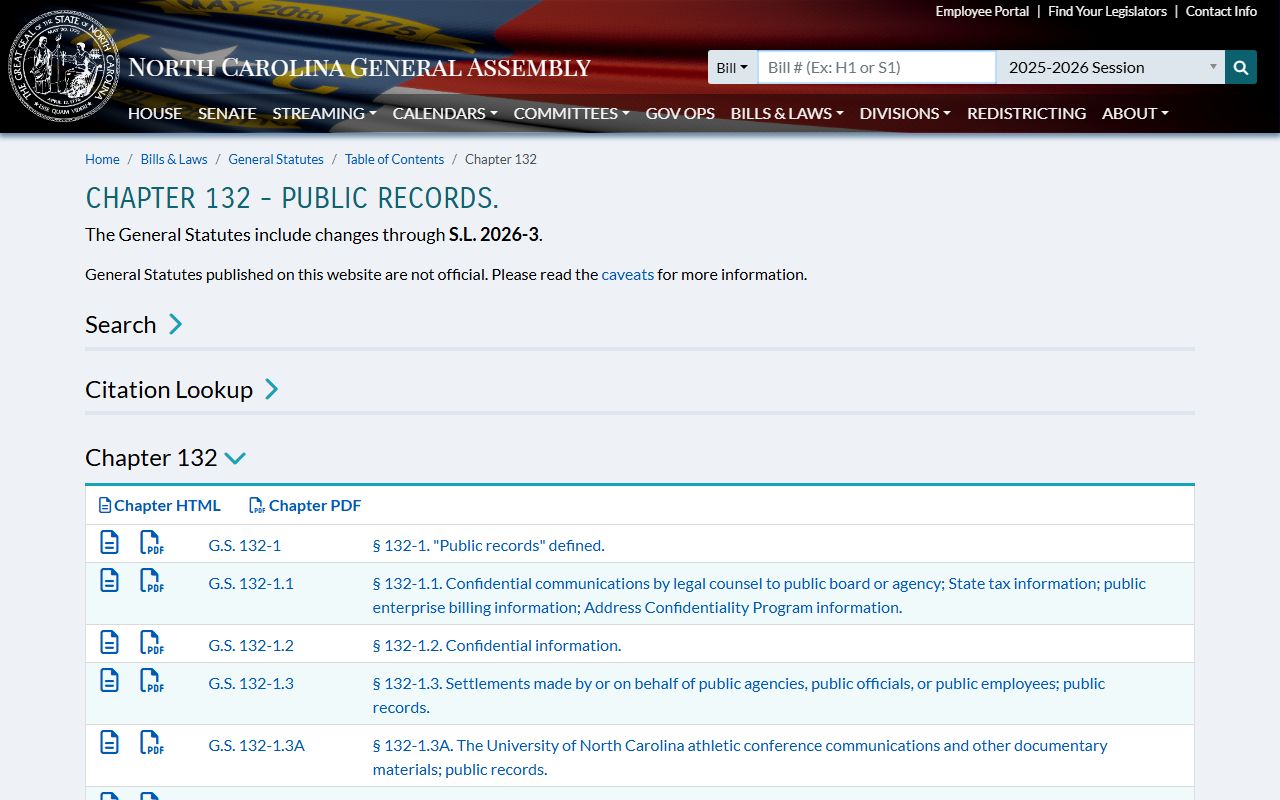
Criminal court access also depends on court-record rules, confidentiality statutes, and orders that seal or expunge a case.
Search Mitchell County Criminal Cases
Mitchell County converted to eCourts on July 21, 2025. Criminal court records are searched through the NC eCourts Portal by using Smart Search for case records and Search Hearings for court dates. The Portal supports record-number searches, name searches, county filters, case-type filters, case-status filters, file-date filters, and hearing searches by party, case number, business, attorney, judicial officer, courtroom, county, and date range as available.
- Open the NC eCourts Portal and choose Smart Search for the criminal case record.
- Search by case number when available, or enter the defendant name in Last, First Middle Suffix format.
- Select Mitchell County in the location filter to reduce statewide false matches.
- Use case type, case status, file date, or date-of-birth filters only when those details are known.
- Open the matching case and review docket entries, hearings, charges, disposition, and payment information.
- Request copies or criminal background searches from the Mitchell County Clerk of Superior Court when Portal detail is not enough.
The Judicial Branch cautions that background checks should be requested from the county clerk rather than relying only on Portal. The Clerk of Superior Court is at the Mitchell County Courthouse, 328 Longview Drive, Bakersville, North Carolina 28705, and the main courthouse number is (828) 688-5100.
Mitchell County Criminal Case Flow
A criminal court record grows as the case moves through the trial-court system. The first public court entries may be tied to an arrest, citation, warrant, initial appearance, bond condition, or charging document. Later entries can show probable-cause events, indictment, arraignment, pretrial motions, plea negotiations, trial settings, verdicts, dispositions, sentencing, probation, costs, restitution, and compliance events.
Case flow: Charges Filed › Arraignment › Pretrial / Motions › Plea or Trial › Disposition › Sentencing
| Stage | What Happens |
|---|---|
| Charges Filed | The allegation is filed after arrest, citation, warrant, indictment, or other charging action. |
| Arraignment | The charge is formally addressed and the defendant may enter a plea. |
| Pretrial / Motions | Parties ask the judge for rulings, seek continuances, handle discovery issues, or resolve bond and scheduling matters. |
| Plea or Trial | The case resolves by plea, trial verdict, dismissal, or another court action. |
| Disposition | The docket shows the outcome for a charge or case, such as guilty, not guilty, dismissed, responsible, or judgment entered. |
| Sentencing | The record may show active time, probation, fines, costs, restitution, or other court-ordered conditions. |
What Mitchell County Criminal Records Show
The exact field set depends on the case type, court level, security restrictions, document scanning status, and whether the paper file predates the eCourts conversion. For Track 9 cases existing on July 21, 2025, the Judicial Branch noted that paper documents existing at go-live remain available in paper form in the clerk's office. Portal and clerk-office access are related, but they are not the same as unrestricted internet publication.
| Field | What It Shows |
|---|---|
| Case Number | The court record identifier used for Portal lookup, hearings, payments, and copy requests. |
| Defendant | The person charged in the criminal case, subject to redactions and access limits. |
| Charge | The criminal offense allegation filed after arrest, citation, indictment, or warrant. |
| Offense Description / Statute | The offense label and, when shown, the statutory reference tied to the charge. |
| Bond / Release Conditions | Secured bond, unsecured bond, written promise, or other release terms when part of the public record. |
| Hearings and Docket Entries | First appearance, probable cause, arraignment, motions, continuances, plea, trial, and other events. |
| Plea | The defendant's response to the charge, such as guilty, not guilty, or no contest where allowed. |
| Disposition | The outcome of each charge or case, including dismissed, guilty, not guilty, responsible, or judgment entered. |
| Sentence | Active term, probation, fines, costs, restitution, and other ordered conditions where visible. |
| Compliance / Payment Status | Eligible costs, fines, restitution, probation, or payment information supported by Portal tools. |
Mitchell County Criminal Court Roles
The District Attorney prosecutes state criminal cases after charges enter the court system. Mitchell County is in Prosecutorial District 35. The North Carolina Conference of District Attorneys identifies Seth Banks as District Attorney for Avery, Madison, Mitchell, Watauga, and Yancey counties. The main office is at 842 W. King St., Boone, North Carolina 28607, phone (828) 268-6610, and the Mitchell courthouse contact directory also lists District Attorney at (828) 688-5110.
Public defense is separate from prosecution. Indigent Defense Services identifies Mitchell County as Defender District 24 and directs users to contact the Clerk of Superior Court at (828) 688-5100 to find out whether they have a lawyer. If the defendant knows the lawyer's name, IDS directs the person to attorney lookup contact information. The DA and defense systems affect case activity, but the court file remains with the Clerk of Superior Court.
| Office | Criminal Case Role | Record Custody |
|---|---|---|
| Clerk of Superior Court | Maintains criminal case files, dockets, copies, payments, and background-search access through the county clerk. | Primary local custodian for the court file. |
| District Attorney District 35 | Represents the State after charges are filed and prosecutes criminal cases. | Not the general custodian of the full court file. |
| Indigent Defense Services | Helps route public-defense questions for eligible defendants. | Does not replace clerk access to court records. |
| District Court | Handles misdemeanors, infractions, initial appearances, and preliminary felony events. | Records are kept through the Clerk of Superior Court. |
| Superior Court | Handles felony trials and felony dispositions. | Records are kept through the Clerk of Superior Court. |
Mitchell County Charges vs Convictions
A charge is not a conviction. A Mitchell County criminal court record can show charges that were dismissed, reduced, amended, or resolved with a not-guilty finding. A conviction is the result after a guilty plea, verdict, or other qualifying court finding. That distinction matters for background checks, employment questions, housing questions, licensing, immigration, and personal record review.
| Feature | Charge | Conviction |
|---|---|---|
| Meaning | An accusation filed in court after arrest, citation, warrant, indictment, or other charging action. | A final finding or plea that the defendant is legally responsible or guilty. |
| Case stage | Early or pending stage of the criminal case. | Later result after plea, verdict, or court judgment. |
| Possible outcome | May be dismissed, amended, reduced, tried, or resolved by plea. | May lead to sentence, probation, fine, cost, restitution, or other court order. |
| Public record issue | May appear even when no conviction follows. | May remain public unless sealed, expunged, or restricted by law. |
Read Dispositions and Sentences
A disposition is the outcome of a charge or case. Common plain-English outcomes include dismissed, guilty, not guilty, responsible, or judgment entered. Sentencing information may include probation, active incarceration, court costs, fines, restitution, and compliance conditions. A docket may show the result in a short entry, while a judgment or sentencing document gives more detail when the document is public and available.
Use care with old or transition-period records. Mitchell County's eCourts go-live was July 21, 2025, and paper documents that already existed at go-live remain available in paper form at the Clerk of Superior Court's office. If a Portal result shows a disposition but not the document needed, the clerk is the local copy source.
Sealed or Expunged Criminal Records
North Carolina uses "expunction" and "expungement" for the process that removes eligible records from ordinary public criminal record systems by court order. A person generally files a petition in the county where the charge or conviction occurred and uses Judicial Branch expunction forms through the Clerk of Superior Court. The process is record-specific, so one order should not be assumed to remove every arrest, citation, warrant, civil file, or jail mention.
| Feature | Sealed | Expunged |
|---|---|---|
| Visibility | Closed to ordinary public inspection by law or court order. | Removed from ordinary public criminal record systems by court order. |
| Legal basis | Depends on statute, court rule, or court order. | Depends on a specific expunction statute and eligibility facts. |
| Examples | Juvenile, adoption, mental health, protected address, or sealed case material. | Dismissed or not-guilty charges under N.C.G.S. 15A-146, or certain eligible nonviolent offenses under N.C.G.S. 15A-145.5. |
| Practical result | The public may not inspect the sealed record without authority. | The covered record is removed or sealed from ordinary public access after the order is granted. |
The Judicial Branch expunction overview explains the forms and general process used in North Carolina.
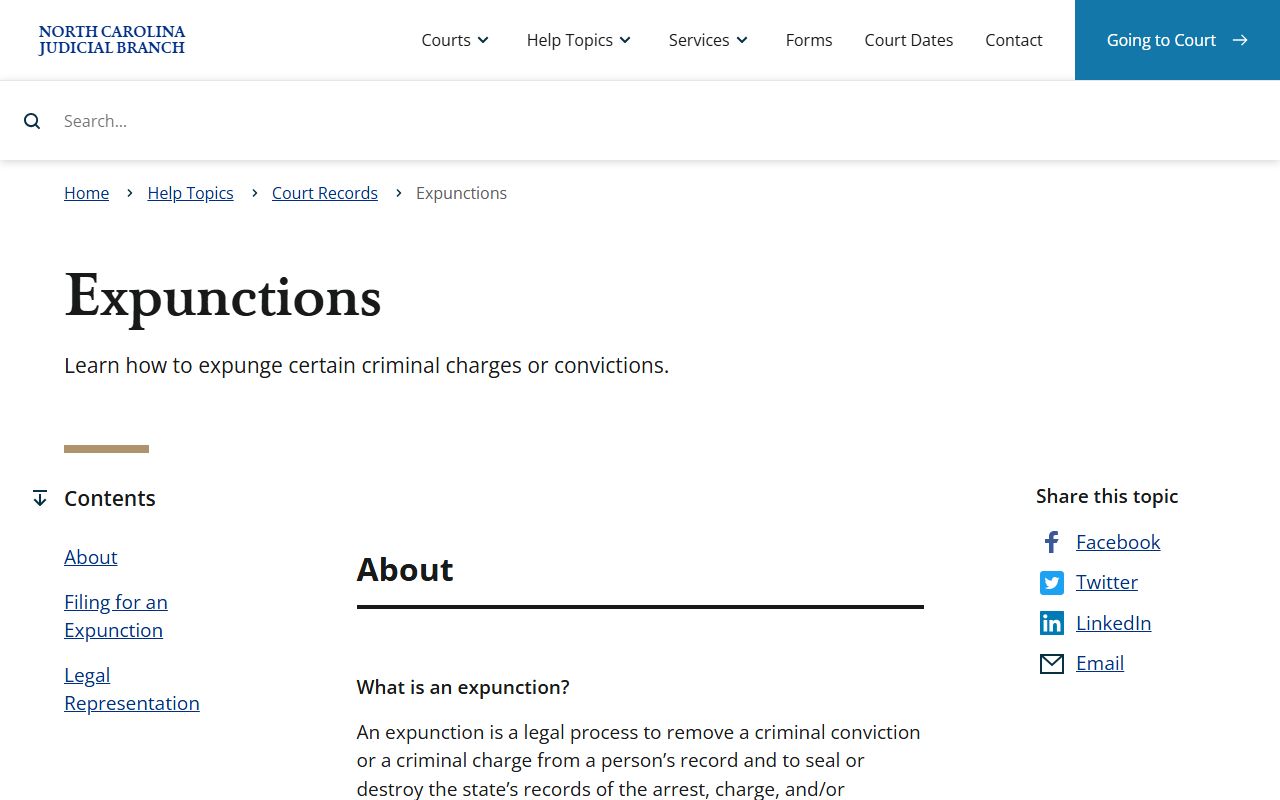
Expunction access is handled through the court process, not by deleting a Portal result on request.
Public Access to Criminal Records
Criminal court files are generally public unless a law, rule, or court order restricts them. N.C.G.S. 7A-109 requires clerks to maintain records, files, dockets, and indexes and states that they are open for public inspection during regular office hours unless prohibited by law. Chapter 132 defines public records broadly, but the court file still must be requested from the proper custodian.
Key Statutes:
N.C.G.S. Chapter 132 - defines North Carolina public records for state and local agencies.
N.C.G.S. 7A-109 - requires clerks to keep records, files, dockets, and indexes open unless law restricts access.
N.C.G.S. 7B-3000 - makes juvenile court records confidential except as statute or court order allows.
Restricted Mitchell County Criminal Records
Juvenile delinquency and undisciplined records are confidential and are not public criminal court records. Adoption material, mental health commitment materials, sealed files, expunged records, protected addresses, Social Security numbers, financial account numbers, and minor information may be withheld or redacted. Portal access and clerk access do not make those records open to all users.
N.C.G.S. 15A-145.5 covers expunction eligibility for certain nonviolent misdemeanors and felonies.
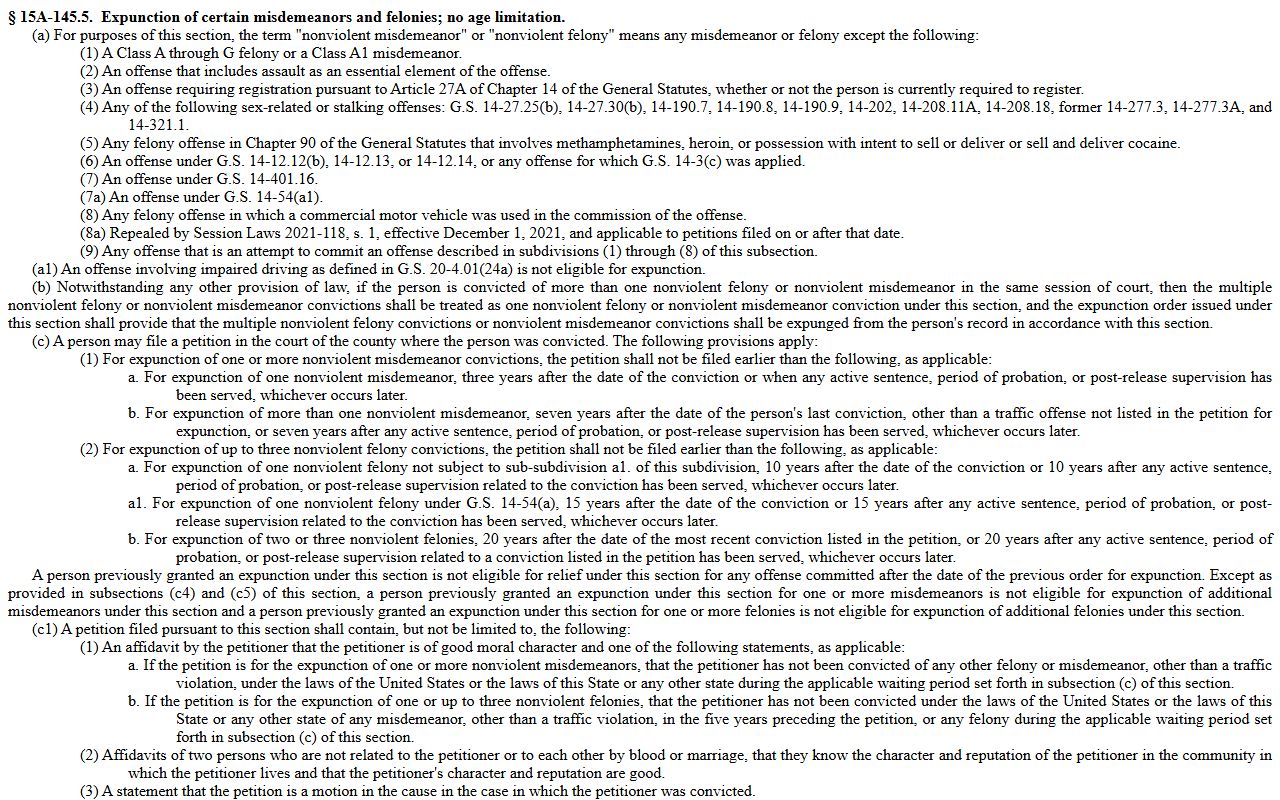
That statute is not a blanket removal rule; eligibility depends on the specific offense, waiting period, prior record, and exclusions.
N.C.G.S. 15A-146 addresses expunction after dismissal, not-guilty findings, or not-responsible findings.
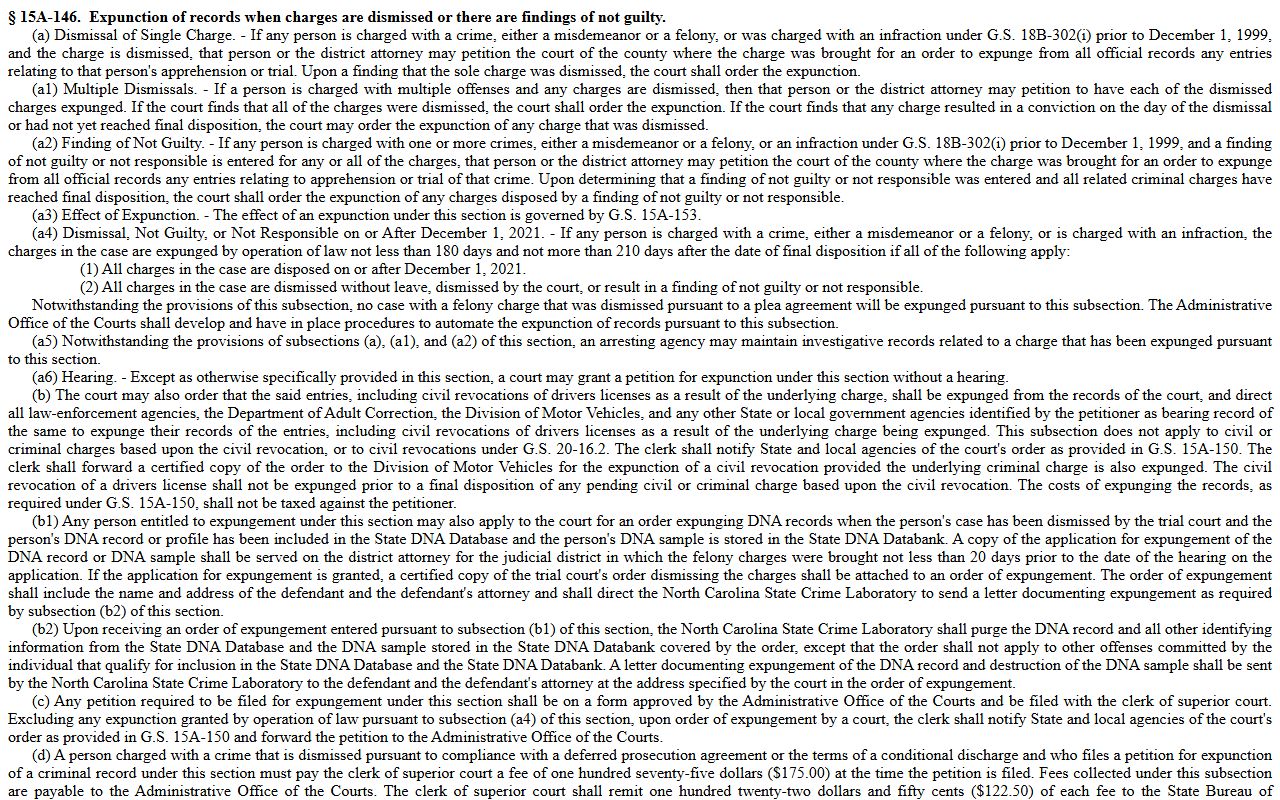
For Mitchell County cases, petitions are filed in the county where the charge or conviction occurred through the Clerk of Superior Court.
Note: A public docket may show a charge history that is not the same as a conviction history.