
How to Search Mitchell County Traffic Court Records
Mitchell County traffic court records are searched through the NC eCourts Portal because Mitchell County converted to the statewide eCourts environment on July 21, 2025. The Portal provides Smart Search for case information, Search Hearings for court dates, Make Payments for eligible criminal and infraction matters, and judgment search. For a traffic case, the most useful starting point is the citation number or record number. A name search can also work, but it may return more than one person or case if the name is common.
The Portal requires JavaScript and cookies, supports current and recent major browser releases, and may require a CAPTCHA every ten minutes. If the Portal is unavailable or a traffic citation is not visible, the North Carolina Judicial Branch says the person remains responsible for paying on time or appearing as listed on the citation. The fallback for Mitchell County traffic court records is the Clerk of Superior Court, not a statewide administrative public-record request, because the clerk is the county custodian for local court files and paper records.
- Open the NC eCourts Portal and choose Smart Search for case information or Search Hearings for a court date.
- Enter the citation number, record number, or the person's name in Last, First Middle Suffix format.
- Use advanced filters to narrow the location to Mitchell County and choose date, case status, or case type filters when available.
- Review the case number, charge, hearing date, payment status, disposition, and any listed court cost or compliance entry.
- For certified copies, older paper files, or payment questions that the Portal does not answer, contact the Mitchell County Clerk of Superior Court.
The Mitchell County payment information page is the local source for court payment methods tied to the courthouse. That page matters because traffic payments are not only an online issue. Cashier payments, certified checks, money orders, credit or debit cards, and online card payments each have different rules.
The traffic help topic from the Judicial Branch includes a direct warning from the traffic violations source: online payment is an alternative to in-person or mail payment, but it does not excuse a missed deadline. Mitchell County traffic records should therefore be checked early, with a clerk contact if the citation does not appear.
Which Courts Handle Traffic Cases in Mitchell County
North Carolina does not use a separate county court, municipal court, or justice-of-the-peace court system for Mitchell County traffic cases. Traffic infractions and misdemeanor traffic matters are District Court matters within the statewide General Court of Justice. The Clerk of Superior Court keeps the local case file, accepts court payments through the clerk's cashier process, provides paper file access, and helps route citation questions for cases filed in Mitchell County.
District Court also handles misdemeanors, infractions, juvenile matters, domestic cases, small civil matters, and magistrate matters. Magistrates operate within District Court and may handle initial criminal process, while Superior Court handles felony matters and appeals from District Court. That structure is important when a traffic stop turns into a more serious criminal case. A routine waiver citation may stay in traffic payment channels, while impaired driving or another criminal traffic charge can be part of a broader criminal case file.
| Court or Office | Traffic Role | Address / Contact |
|---|---|---|
| District Court District 35 | Traffic infractions, misdemeanor traffic cases, and related hearings | Mitchell County Courthouse, 328 Longview Dr, Bakersville, NC 28705 |
| Clerk of Superior Court | Traffic files, court dates, payments, public terminals, copies, and local case questions | 328 Longview Dr, Bakersville, NC 28705; (828) 688-5100 |
| Magistrates | Initial process and limited District Court duties tied to some criminal matters | (828) 520-1500; alternate (828) 688-5119 |
Mitchell County Traffic Case Types
Mitchell County traffic court records may involve infractions, waiver matters, misdemeanor traffic charges, compliance matters, and payment entries. The research did not identify a separate Mitchell County photo-enforcement court or a county-run municipal traffic court. For that reason, the local traffic record path centers on District Court, Portal case information, Portal hearing searches, online payment services where a case is eligible, and the Clerk of Superior Court.
- Infractions - These include traffic matters that may be resolved by waiver or court appearance if eligible.
- Misdemeanor traffic cases - These can carry criminal case entries and may require court appearance.
- Compliance matters - Some citations may involve proof of compliance, dismissal requests, or reductions if available.
- Payment cases - Eligible matters can be paid online or through the clerk's cashier process.
- Driver-license consequences - License status, points, suspensions, and restoration questions belong with NCDMV driver-record services.
An image captured from the Judicial Branch traffic violations resource reflects the statewide process that Mitchell County uses for citation payment and appearance choices.
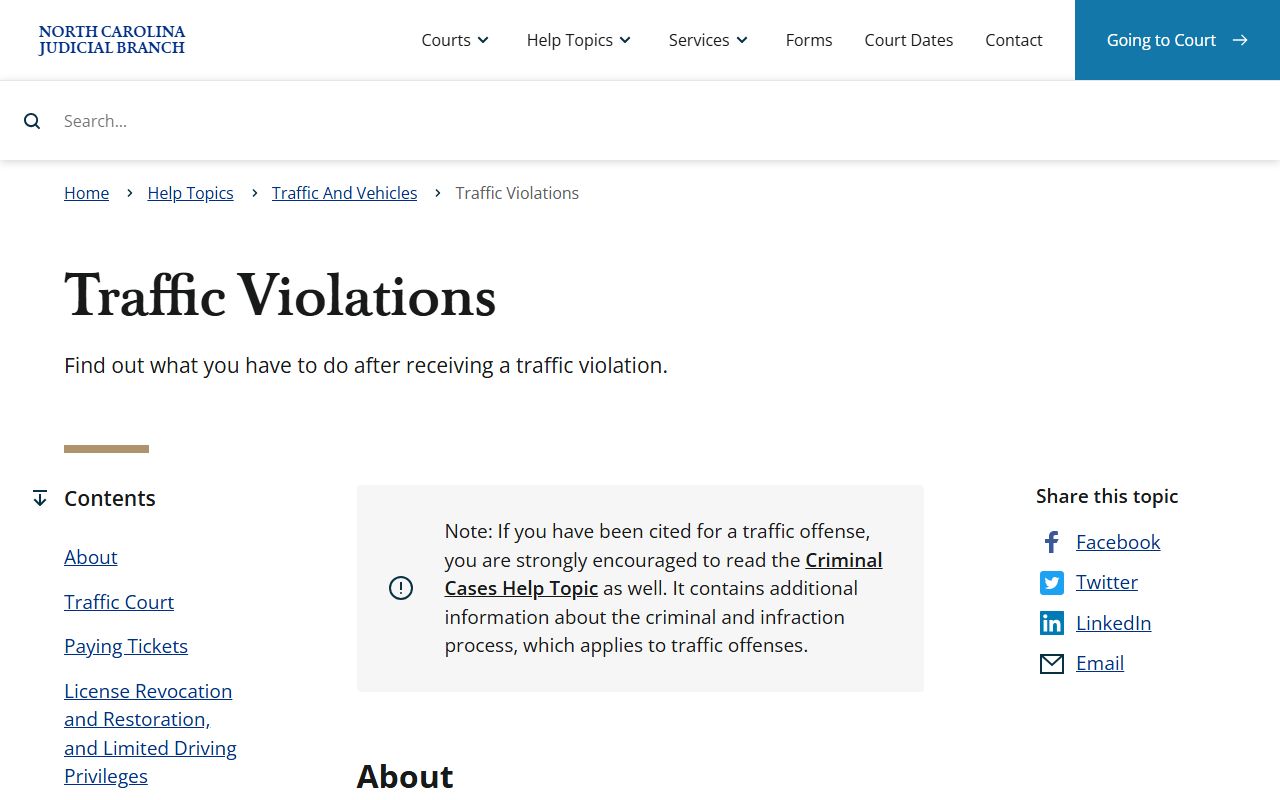
That source supports the local rule of thumb: search the court case first, then confirm any payment, waiver, or court-date question with the clerk when the online record is unclear.
What Mitchell County Traffic Court Records Show
A Mitchell County traffic court record is a court case file or case-information entry, not the same thing as a complete driving history. It can show the citation number, case number, county, court division, charge description, filing or citation date, court date, hearing history, disposition, fines, costs, payment status, and compliance entries. Exact visibility depends on the case type, Portal status, restrictions, and whether a file began before full eCourts availability.
| Field | What It Shows |
|---|---|
| Citation or record number | The identifier used to locate the traffic case in Portal or payment services. |
| County and court division | Shows Mitchell County and the District Court setting for traffic matters. |
| Charge or offense description | Identifies the traffic allegation, infraction, or misdemeanor charge filed with the court. |
| Hearing date | Lists scheduled court dates or hearing entries when available. |
| Disposition | Shows the result, such as responsible, not responsible, dismissed, guilty, or other court action. |
| Costs, fines, and payment status | Shows court financial entries, payment eligibility, and whether an amount has been paid or remains due. |
| Compliance or dismissal entry | May show proof, reduction, dismissal, or compliance activity if the case qualifies. |
North Carolina court terminology can be precise. A disposition is the outcome of a charge or case. A waiver is a way to resolve an eligible citation without appearing in court, but it can still have consequences. A docket is the chronological list of case events. Those terms help separate a court traffic record from an NCDMV driver record.
Mitchell County Citation Search Fields
Portal Smart Search allows record-number and name searches, while Search Hearings supports court-date searches. Citation number searches are usually cleaner because the number points to one traffic record. Name searches are useful when the citation is missing, but the Portal instructions require a specific name format and offer wildcard rules for broader results. Business-name rules are also available in Portal, though most Mitchell County traffic citation searches are tied to a person.
| Search Field | Type | Required | Notes / Format |
|---|---|---|---|
| Record number / citation number | Text | Yes if searching by citation | Portal Smart Search supports record numbers; online payments often require a case or citation number. |
| Name | Text | Alternative search path | Use Last, First Middle Suffix format; wildcard person search may use at least three last-name characters and one first-name character plus an asterisk. |
| Location | Dropdown | Recommended | Select Mitchell County when using advanced filters. |
| Case type / status | Dropdown | Optional | Use traffic or infraction filters where available. |
| Hearing date range | Date | Optional | Search Hearings can use date ranges with county and case filters. |
| Payment workflow | Payment screen | Conditional | Eligible cases only; credit or debit card payments include processing fees. |
The Portal field set is also used by people who need broader Mitchell County court records, so traffic searches benefit from the same spelling and filter rules used for civil, criminal, estate, and special proceeding files.
Paying or Contesting a Mitchell County Traffic Ticket
Mitchell County traffic citation payments may be made at the cashier's office in the Clerk of Court's office. The researched local payment page lists cash, credit or debit card with processing fees, money order, and certified check. Personal checks are not accepted. Online court payments are available for eligible matters through court services, with credit or debit card processing fees. The Portal notice lists Visa, MasterCard, and Discover for accepted online cards, and the court-costs materials explain that eligible online payments may include probation, parole, criminal, and infraction cases.
Paying a traffic ticket can be a legal resolution, not just a bill payment. The court-costs page says that if a person is pleading guilty by waiver or paying a judgment imposing unsupervised or no probation, the full amount due must be paid. If the goal is to contest a citation, ask for a reduction, prove compliance, or avoid a license consequence, the safer path is to review the citation and contact the Mitchell County Clerk of Superior Court before paying.
Important: Paying an eligible traffic citation may resolve the court case, but it does not answer every NCDMV, insurance, CDL, or license-restoration question.
The local court payment screenshot source is the Mitchell County payment information page.
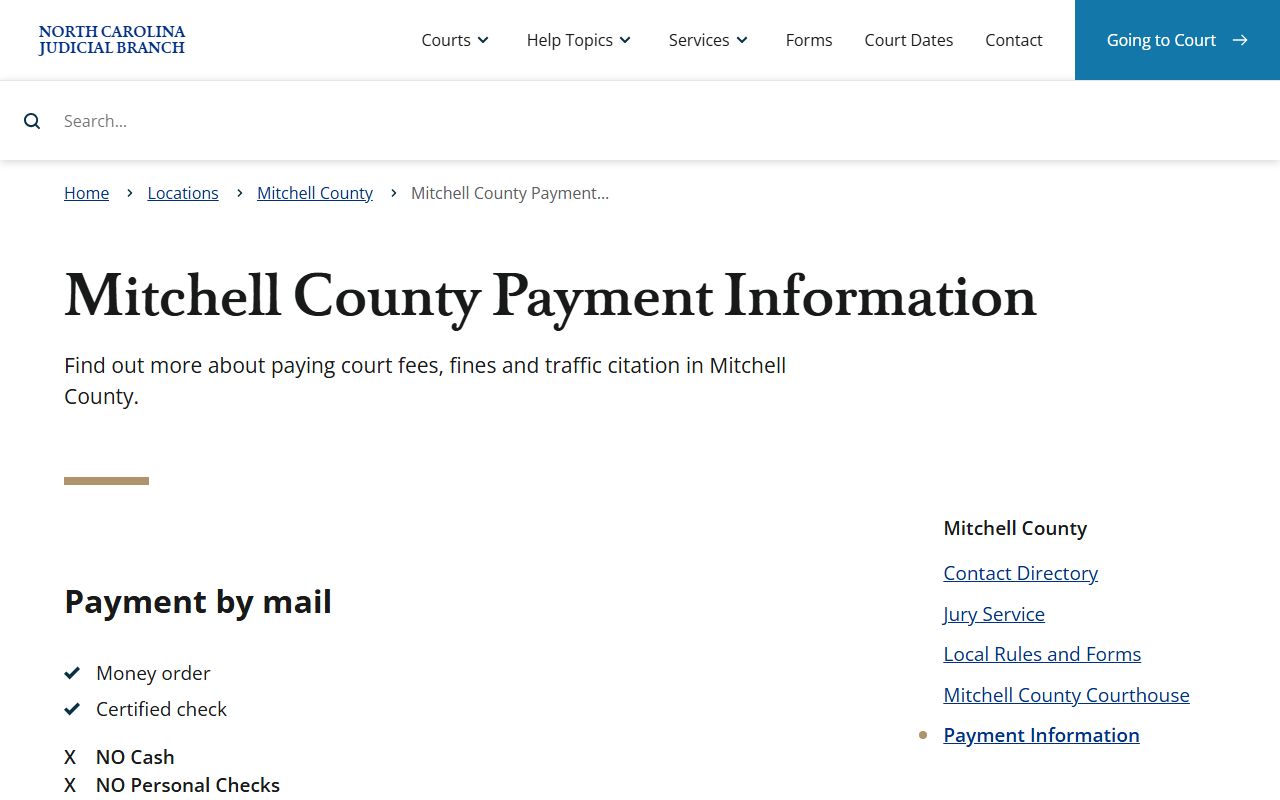
That page ties the online record to the courthouse payment channel, which is useful when a traffic record has a deadline but the Portal does not complete the task.
Public Access Laws for Traffic Court Records
Mitchell County traffic court records are public unless a statute, court rule, or court order restricts the record. North Carolina law requires clerks to keep court records, files, dockets, and indexes, and the research states that these are open for public inspection during regular office hours unless access is prohibited by law. Online Portal access is helpful, but it does not replace the clerk's office for paper files, certified copies, or older documents not fully available in the system.
Key Statutes:
N.C.G.S. Chapter 132 defines public records broadly for North Carolina state and local agencies.
N.C.G.S. 7A-109 requires clerk recordkeeping and public inspection of court records unless the law restricts access.
N.C.G.S. 7B-3000 keeps juvenile court records from ordinary public inspection except by statute or court order.
The juvenile confidentiality statute is relevant because some traffic-related matters involving minors may not be visible like an adult infraction. The screenshot source for this restriction is N.C.G.S. 7B-3000.
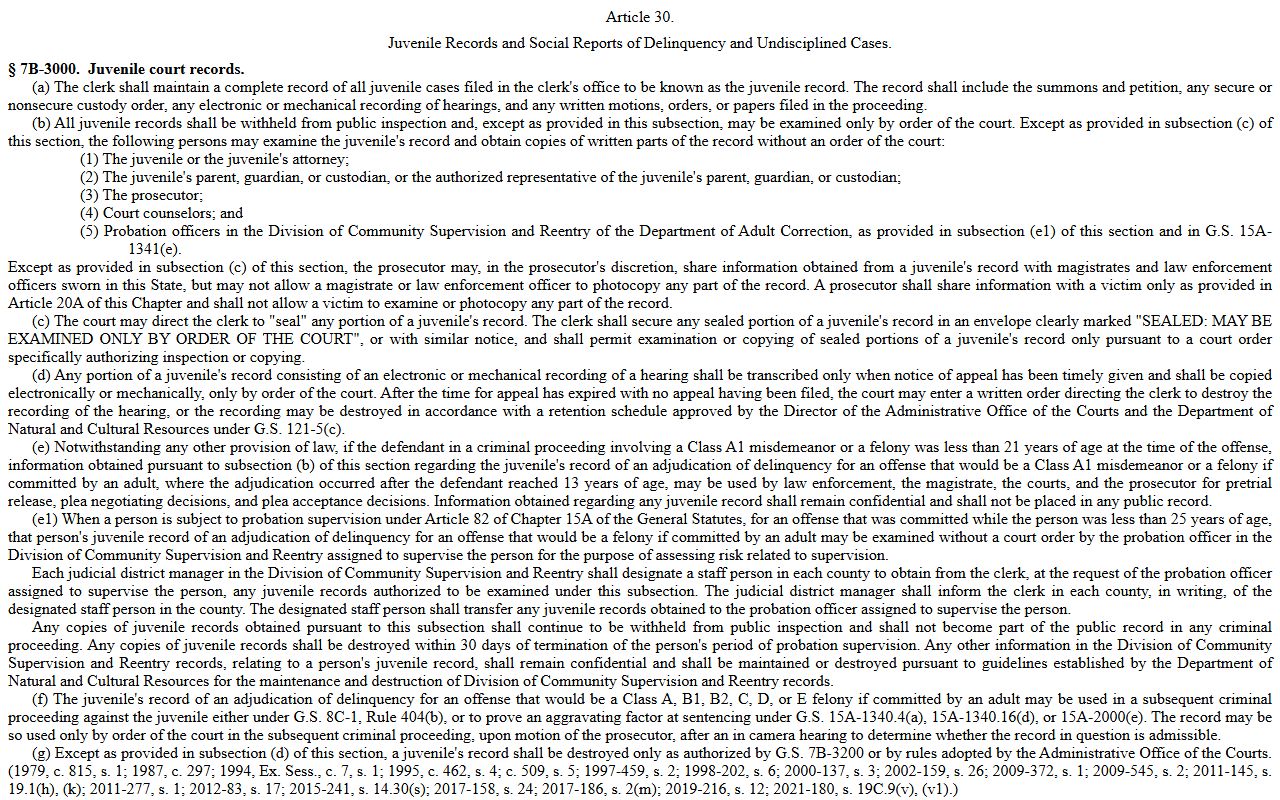
Adult traffic files are generally more open, but restricted juvenile material, sealed records, protected identifiers, and expunged matters should not be expected in public traffic searches.
Court Traffic Records vs State Driver Records
The court traffic record and the state driver record answer different questions. The court record shows what happened in the Mitchell County case. It is kept through the Clerk of Superior Court and the Judicial Branch. The state driver record is kept by NCDMV and shows license status, convictions reported to DMV, points, suspensions, and restoration issues. A dismissed court case may not carry the same driver-record effect as a responsible or guilty disposition, and a paid court case may still require separate license follow-up.
| Feature | Court Traffic Record | State Driver Record |
|---|---|---|
| Custodian | Clerk of Superior Court / NC Judicial Branch | NCDMV |
| Main content | Citation, charge, court date, plea or waiver, disposition, fines, costs, and compliance | License status, convictions reported to DMV, points, and suspensions |
| Access path | NC eCourts Portal, Search Hearings, payment services, clerk office, public terminal | NCDMV driver-record request services |
| Common use | Court appearance, ticket payment, contesting a citation, certified court disposition | Insurance, employment driving checks, license restoration, point review |
| Error correction | Start with the clerk if the court case entry or disposition is wrong | Start with NCDMV if the license history or point record is wrong |
Mitchell County CDL Traffic Records
Commercial driver questions should be handled with care because a traffic court outcome can affect employment and licensing outside the court file. The research did not provide a Mitchell County CDL diversion program or a local commercial-driver court. It did document the split between the court traffic record and the state driver record. CDL holders should search the Mitchell County court case for the citation, disposition, and payment status, then check NCDMV driver-record channels for license consequences.
For court purposes, the Clerk of Superior Court can answer local case and payment questions. For license status, points, suspensions, or restoration, the driver-record side is separate. That distinction is especially important if a person pays a citation online and assumes the driver record has been cleared. Court payment and driver-license restoration are not the same task.
Mitchell County DWI Court Records
Driving while impaired is not just a routine traffic payment issue. A DWI can appear as a criminal traffic matter, with court dates, charge entries, possible bond or release conditions, motions, disposition, sentencing, costs, and license consequences. District Court may handle misdemeanor traffic matters, while felony-level issues and later case stages can involve Superior Court depending on the charge.
For the full criminal case file, including pleas, disposition, and sentence, use the Mitchell County criminal court records path rather than relying only on a traffic payment screen.
Dismissals, Reductions, and Compliance
The Mitchell County research does not document a county-specific deferred adjudication or defensive-driving program by name. It does show that online citation services may be used for eligible reductions, compliances, dismissals, or payments as available. Eligibility depends on the citation, court rules, and the options shown through the Judicial Branch service or confirmed by the clerk.
If a traffic record shows a compliance issue, the person should review the citation, search the Portal, and contact the Clerk of Superior Court before the court date or payment deadline. A dismissed or reduced charge may affect the court record and the driver record differently, so the final court disposition should be checked separately from any NCDMV point or license question.
The court-costs screenshot source is the Judicial Branch court costs page.
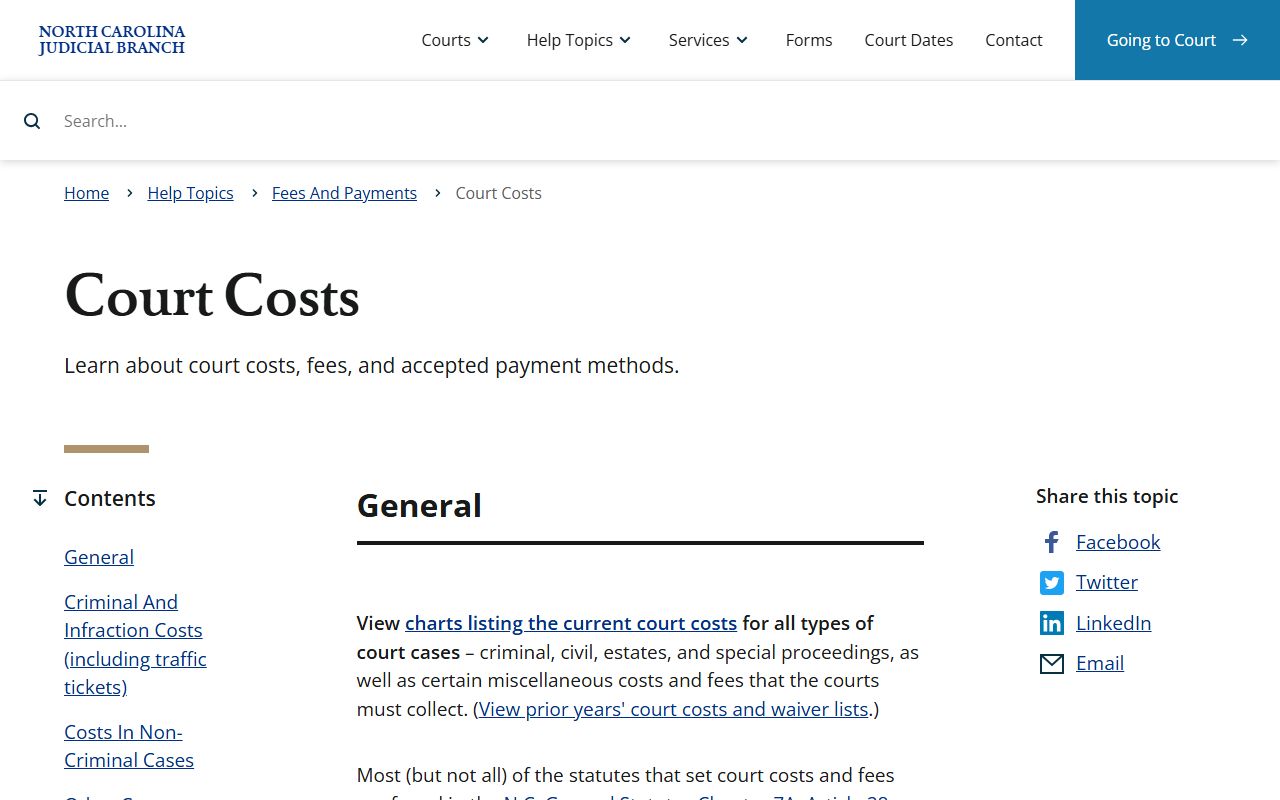
That statewide payment source helps explain when an online payment must be full and why payment terms can differ from one traffic record to another.
Restricted Mitchell County Traffic Records
Not every traffic-related entry is open online. Juvenile court records are confidential under North Carolina law unless access is allowed by statute or court order. Sealed and expunged records are also outside ordinary public inspection. Protected addresses, Social Security numbers, financial account numbers, and other sensitive identifiers may be redacted even when the case itself is public.
North Carolina expunction statutes in the research include provisions for certain dismissed or not guilty charges and for some nonviolent misdemeanors or felonies. Those statutes are more often discussed in criminal-record contexts than routine traffic ticket searches. If a Mitchell County traffic matter is tied to a criminal charge, the expunction issue should be checked through the clerk and the relevant criminal-record process rather than assumed from the public Portal result.
Note: Portal visibility is not a guarantee that every paper document, restricted filing, or older traffic record is available online.
Fees for Traffic Record Copies
The research provides Mitchell County traffic payment methods and several related copy or vital-record fees, but it does not provide a county-specific per-page court copy fee for traffic files. For that reason, traffic record copy costs should be confirmed with the Clerk of Superior Court before ordering copies. The fee facts that are available are still useful for the payment side of a traffic case.
| Item | Amount or Payment Rule |
|---|---|
| In-person Mitchell County court payment | Cash, credit/debit card with processing fees, money order, or certified check |
| Personal checks for court payments | Not accepted |
| Online court payments | Credit/debit card plus processing fees for eligible matters |
| Plain or certified traffic file copies | Confirm current copy fee with the Clerk of Superior Court |
| NCDMV driver record | Separate state driver-record request, not a Mitchell County court copy |
Certified court dispositions are usually needed when a third party asks for proof of the court outcome. A Portal screen can help identify the case, but it should not be treated as a certified copy unless the clerk issues it as one.