
Mitchell County Arrest Records and Charges
Mitchell County arrest records begin with the arresting agency or a magistrate process. The official county law-enforcement agency is the Mitchell County Sheriff's Department, led by Sheriff Donald Street. Sheriff records may help with current custody routing, arrest questions, and booking process questions, but the reviewed official county sources did not publish a public local booking database. For custody status, the inmate record path starts with the sheriff phone lines and, when appropriate, state or regional detention resources.
Court charges after arrest are different. A charge record identifies the allegation filed into court, the offense description or statute, the case number, the court division, bond or release conditions when visible, and later charge status. In Mitchell County, these court entries are searched through the NC eCourts Portal and through the Clerk of Superior Court. The full criminal case file, including pleas, motions, disposition, sentencing, costs, and probation terms, belongs with the Mitchell County criminal court records workflow.
The arrest-to-charge path can cross several offices. Law enforcement may make the arrest. A magistrate may handle initial criminal process and release terms. The District Attorney decides how the State will prosecute filed charges. The Clerk of Superior Court keeps the court file and indexes. That separation is why a name search in one source may show only part of the story.
Search Mitchell County Charges After Arrest
For filed court charges, start with Portal rather than a jail roster. Mitchell County joined the eCourts environment with Track 9, so criminal, civil, special proceeding, and estate case information may be searched online where the record is available. Portal is not a background-check product and is not a sheriff booking log. It is the public court case tool for case status, court dates, parties, charge entries, judgments, and payment information where the record is public.
- Open the NC eCourts Smart Search page and search by defendant name or case number.
- Set the location or county filter to Mitchell County when the interface offers a county or location option.
- Open the matching criminal case and read each charge entry separately, since one arrest can produce more than one count.
- Compare the filed charge, current status, hearing dates, disposition, bond condition, and costs before treating the record as final.
Paper files still matter. The research notes that documents existing in paper form at the eCourts go-live remained available in the clerk's office. For certified copies, older files, background-check requests, or a record that does not display as expected online, contact the Mitchell County Clerk of Superior Court instead of assuming Portal is complete.
The official Prosecutorial District 35 page identifies Seth Banks as District Attorney for Avery, Madison, Mitchell, Watauga, and Yancey counties. That source helps explain who prosecutes state charges, while the clerk remains the record custodian for the court file.
The District Attorney District 35 source documents the prosecutorial district that handles Mitchell County state criminal cases.
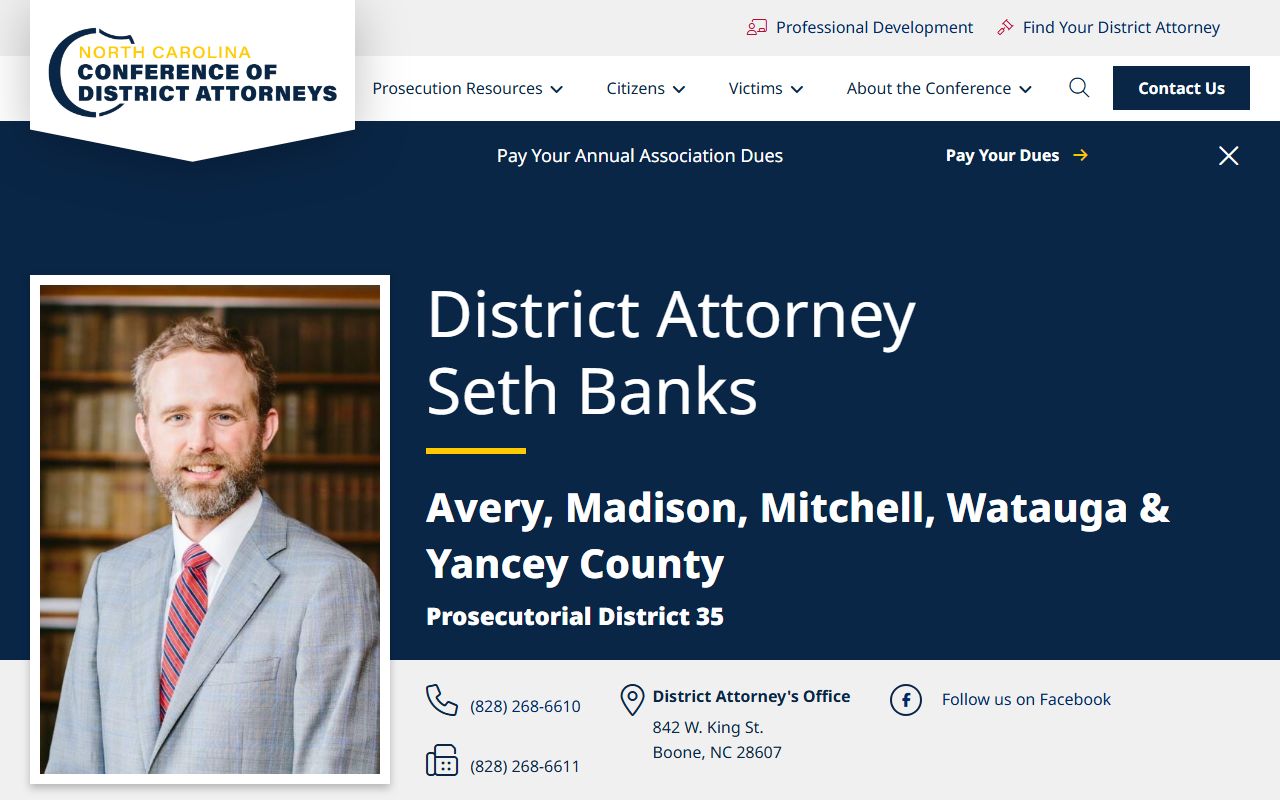
That prosecutor source supports the charge-record distinction: the State's charging and prosecution role is separate from the sheriff's custody information and the clerk's court file.
Mitchell County Charging Documents
A court charge record begins when an accusation is placed into a formal court path. In North Carolina, lower-level criminal matters often begin in District Court, while felony cases may begin with magistrate and District Court events before indictment or transfer to Superior Court. The charge may be tied to an arrest warrant, citation, criminal summons, information, indictment, or other criminal process. The label matters less than the core question: what exact allegation has been filed, and in which court case is it being tracked?
| Charging document | Typical use | What to check |
|---|---|---|
| Complaint or criminal process | Initial allegation after arrest, citation, or magistrate process | Offense description, date, issuing official, case number, release condition |
| Information or prosecutor-filed charge | Formal charge advanced by the State in a criminal case | Whether the filed charge matches, reduces, or replaces the arrest allegation |
| Indictment | Formal felony accusation through the grand jury process | Counts, statutory offense, Superior Court case path, arraignment events |
The researched materials do not provide a Mitchell-only charge-code table, so charge codes should be read from the court entry, the charging paper, or the clerk's file. A case may include misdemeanors, felonies, infractions, probation violations, or several separate counts. If the case has moved from an initial District Court event to Superior Court, compare both case paths before concluding that a charge disappeared.
Mitchell County Charge Status
Charge status changes as the case moves. A filed allegation can remain pending, be amended, be reduced, be dismissed, be resolved by plea, or proceed to trial. Portal and the clerk's file may show the current status, hearing history, disposition, and sentence fields, but the exact visible fields depend on case type, security restrictions, eCourts status, scanned-document availability, and whether a paper file predates Portal access.
| Status | Meaning in a court-charge record |
|---|---|
| Pending | The allegation is still open or no final disposition is visible in the public case information. |
| Amended or reduced | The charge was changed, often to a different offense level or a different offense description. |
| Dismissed | The charge ended without a conviction on that count, subject to the exact court entry. |
| Guilty or responsible | The case ended with a conviction or responsibility finding for that charge or amended charge. |
| Not guilty or not responsible | The court result did not establish guilt or responsibility for that charge. |
Disposition is the outcome of a charge or case. It may be different for each count. One arrest can produce a dismissed count, a reduced count, and a guilty plea on another count. For that reason, read the charge list line by line, not just the case caption.
Indigent Defense Services also has a Mitchell County page that directs users to contact the Clerk of Superior Court to find out if they have a lawyer. That IDS county page is relevant when a defendant is trying to understand representation on filed charges.
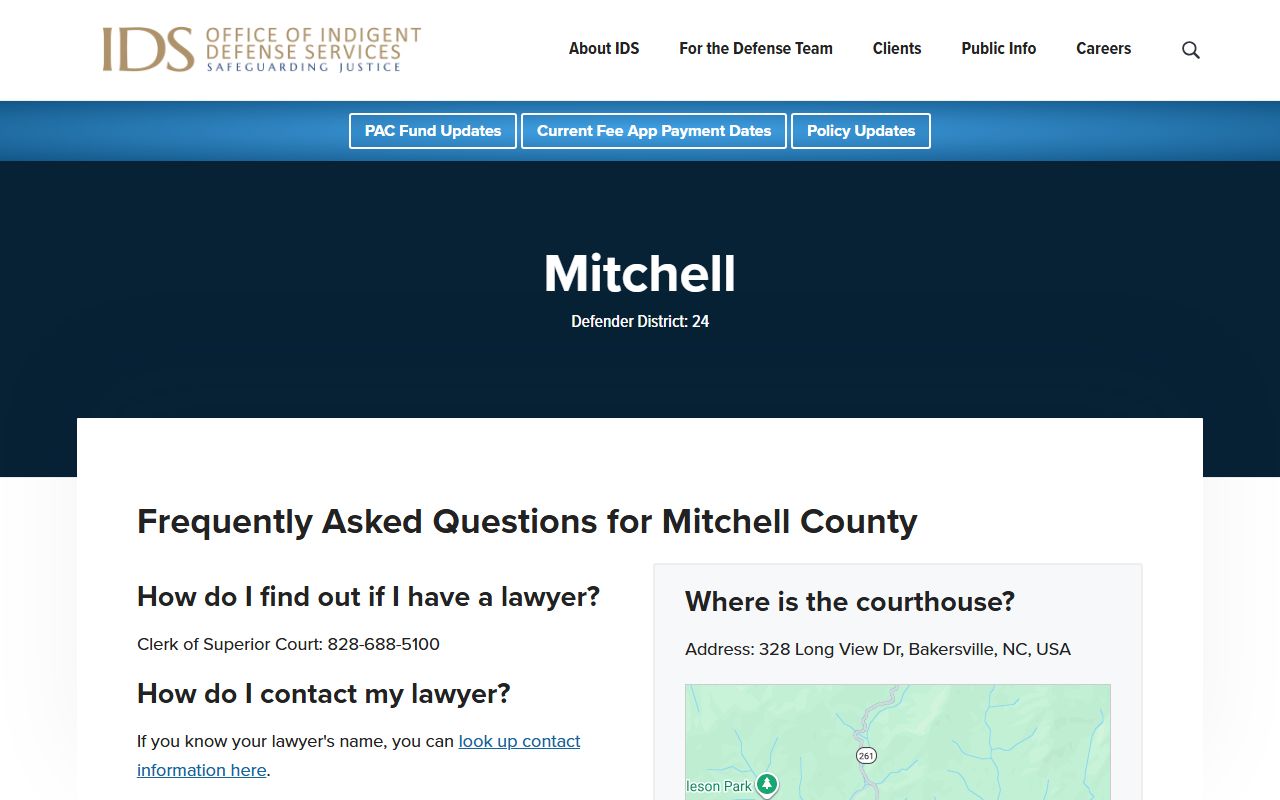
Representation details are not the same as the public charge record, but counsel information can affect how a defendant should respond to a pending charge.
Mitchell County Charges vs Convictions
A charge is an accusation. A conviction is an outcome. Mitchell County court charge records may show arrests and allegations that were later dismissed, reduced, or resolved without a conviction. Background checks and court searches should not treat every listed charge as proof that the person was convicted. The disposition field, judgment, sentence, and later expunction status are the key facts.
| Point of comparison | Charge | Conviction |
|---|---|---|
| Stage | Filed after arrest, citation, warrant, indictment, or other criminal process | Entered after plea, verdict, or other final court action |
| Meaning | An allegation by the State, not proof of guilt | A court outcome finding guilt or responsibility on a count |
| Record location | Portal, clerk file, charging paper, docket entries | Judgment, disposition, sentence, costs, probation entries |
| Can change? | Yes, charges can be amended, reduced, or dismissed | Yes, through appeal, post-conviction relief, or expunction when allowed |
For a complete case outcome, read the criminal case file instead of stopping at the arrest or first charge entry. The Clerk of Superior Court is the local source for court-file copies and certified records. The Sheriff's Department is the better first contact for custody routing or arrest process questions.
Public Access to Mitchell County Charges
North Carolina court records are public unless a statute, court rule, or court order restricts them. N.C.G.S. 132-1 defines public records broadly for state and local agencies. N.C.G.S. 7A-109 requires clerks to keep records, files, dockets, and indexes open for public inspection during regular office hours unless law bars access. Those rules support public inspection of many filed charge records, but they do not make every arrest, juvenile matter, sealed file, or investigative record public online.
The access channel depends on custody of the record. Court case data belongs with Portal and the Clerk of Superior Court. Sheriff incident or arrest information belongs with the Sheriff's Department as the law-enforcement custodian. Administrative Judicial Branch records can use the Judicial Branch public-record request form, but that form is not the right path for local court documents, local case information, background searches, or vital certificates.
Access point: Use Portal for filed case information, the clerk for court files and copies, and the sheriff for arrest or custody records.
Restricted Mitchell County Arrest Records
Some arrest-related and charge-related records are restricted by law. Juvenile delinquency and undisciplined proceedings are not public records under N.C.G.S. 7B-3000. Adoption material, mental health commitment records, sealed records, expunged records, protected addresses, financial account numbers, Social Security numbers, and minor information may be withheld or redacted. Active-investigation materials may also be limited outside the public court case file.
North Carolina uses the terms expunction and expungement for the process that removes eligible records from ordinary public access by court order. N.C.G.S. 15A-145.5 covers certain nonviolent misdemeanors and felonies. N.C.G.S. 15A-146 covers dismissed charges and not guilty or not responsible findings. An expunction is record-specific, so one order should not be assumed to remove every arrest, warrant, charge, custody entry, or related court event.
| Record limit | Effect on public charge access |
|---|---|
| Juvenile record | Withheld from public inspection except by statute or court order |
| Sealed record | Closed to ordinary public inspection by law or court order |
| Expunged record | Removed from ordinary public criminal record systems after eligible court relief |
| Redacted record | Public version may omit identifiers, protected addresses, financial data, or minor information |
The North Carolina juvenile delinquency source explains the confidentiality rule for juvenile records. That Judicial Branch overview is relevant when an arrest or charge involves a youth rather than an adult case.
That restriction is why a missing public charge record does not always mean no court process exists.
Mitchell County DA and Defense Contacts
Mitchell County is in Prosecutorial District 35. The District Attorney's district office is listed at 842 W. King St., Boone, NC 28607, with phone (828) 268-6610 and fax (828) 268-6611. The Mitchell County court contact directory separately lists District Attorney contact at (828) 688-5110. The DA represents the State; the DA is not the custodian of every public court record.
Defender District 24 covers Mitchell County for indigent defense purposes. If a defendant does not know whether counsel has been appointed, the IDS county page points to the Clerk of Superior Court at (828) 688-5100. That is a representation question, not a public-record request, but it often comes up at the same time as charge lookup.
Mitchell County Sheriff's Department
305 Baker Lane
Bakersville, NC 28705
(828) 688-3982
If no answer: (828) 688-9974
Clerk of Superior Court
328 Longview Drive
Bakersville, NC 28705
(828) 688-5100
Use for court files, copies, and local case questions.
Safe Babies Court is not a criminal charge lookup tool, but it is part of the local court ecosystem noted in the research. The statewide Safe Babies Court program page helps identify that family-court program rather than a public criminal charge source.
That distinction keeps family, juvenile, custody, and criminal charge records from being blended into one public-search category.