
What Probate Covers in Mitchell County
North Carolina probate is handled by the elected Clerk of Superior Court in each county rather than by a stand-alone probate court. The Judicial Branch estates help topic states that clerks and assistant clerks hold most estate hearings and preside over most estate cases. In Mitchell County, probate filings go to the Clerk of Superior Court at the Mitchell County Courthouse. If the validity of a will is challenged in a caveat proceeding, that will contest is heard by a Superior Court judge.
Mitchell County probate records can include probate of wills and codicils, applications to open decedent's estates, appointment of personal representatives or administrators, inventories, accountings, notices to creditors, estate distributions, closing papers, small estate procedures when available, guardianships, and special proceedings handled by the clerk. The probate file can be part index record, part paper file, and part clerk order. That is why the search path should include both the NC eCourts Portal and the clerk's office.
The statewide estates screenshot source is the North Carolina Judicial Branch estates help topic.
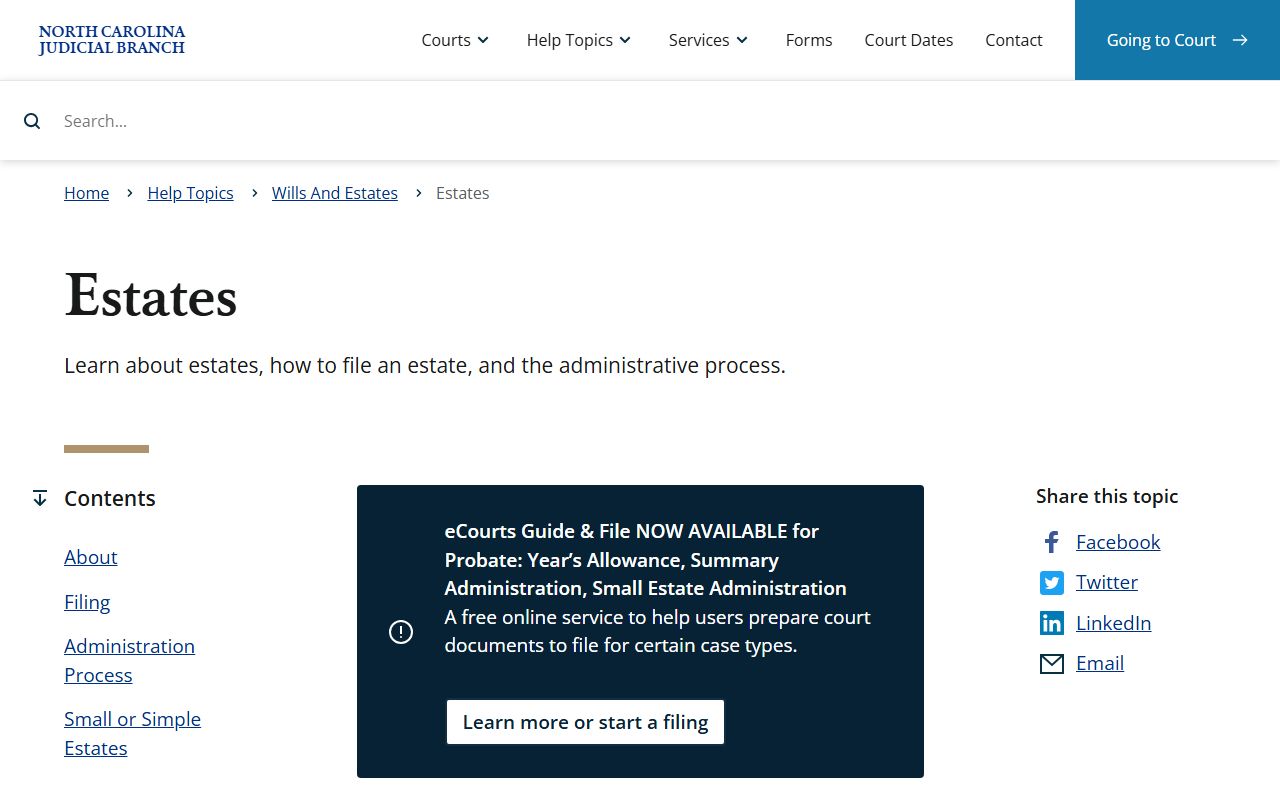
That source confirms the central North Carolina rule for Mitchell County probate records: the Clerk of Superior Court acts as the probate judge.
Mitchell County Probate Terms
Probate files use terms that are not always clear from a Portal search result. These definitions align with the North Carolina court glossary and the estate terms used in the Mitchell County research.
- Testator
- The person who made a will before death.
- Executor
- The person named in a will to carry out estate duties after court appointment.
- Intestate
- A death without a valid will, which usually requires administration under state estate law.
- Guardianship
- A clerk-handled proceeding for appointment of a guardian where a minor or incapacitated adult needs legal protection.
- Conservatorship
- A protective proceeding concerning management of property or financial interests, often discussed with guardianship-type records.
- Personal representative
- A general term for the person authorized to administer an estate.
The Judicial Branch legal glossary is useful when a probate record includes broader court terms such as petitioner, respondent, order, judgment, or special proceeding.
How to Search Mitchell County Clerk of Superior Court acting as probate judge
Mitchell County estate case information may be searched through the NC eCourts Portal, which covers criminal, civil, special proceeding, and estate case information for eCourts counties. Mitchell County went live in eCourts on July 21, 2025. Portal search can identify a case number, decedent name, filing date, case type, status, and hearing entries where available. Older paper documents, original wills filed in an estate, and certified copies still may require the clerk's office.
- Open Portal Smart Search and use the decedent name, estate case number, or party name if known.
- Filter the location to Mitchell County and use case-type, status, or filing-date filters when available.
- Review the index entry for case number, filing date, case type, representative information, and hearing entries.
- Use the public terminal at the clerk's office when online fields do not show enough detail.
- Request paper estate files or certified copies from the Clerk of Superior Court in the county where the estate is filed.
The Judicial Branch public-record form is not the right first stop for a local estate file. The research states that NCAOC is not the custodian of local court documents or case information. For Mitchell County probate records, the local Clerk of Superior Court is the practical custodian for paper files, copies, and probate hearings.
| Channel | How to Use | Limits |
|---|---|---|
| NC eCourts Portal Smart Search | Search Mitchell County and use case type, status, or file-date filters where available. | Older paper documents may not be fully visible. |
| Public terminal at clerk's office | Search estate and special proceeding case information at the courthouse. | Requires a courthouse visit during regular hours. |
| Clerk paper file | View or request copies from the Clerk of Superior Court where the estate is filed. | Copy fees apply and some records may be restricted. |
| Judicial Branch public-record form | Use for NCAOC-held administrative records. | Not for local court documents or estate case files. |
Mitchell County Probate Court Contact
There is one local probate access point in Mitchell County: the Clerk of Superior Court acting as probate judge. The courthouse also houses Superior Court and District Court functions, but estate filings and most estate hearings are clerk matters. A will caveat or will-validity challenge can move before a Superior Court judge, which is why contested probate records may show both clerk and Superior Court activity.
Probate Records
Mitchell County Courthouse
328 Longview Dr
Bakersville, NC 28705
(828) 688-5100
Monday-Friday, 8:30 a.m.-5:00 p.m.
Probate users should not use the Sheriff's Department address for estate filings, and marriage or deed requests should not be sent to the courthouse unless the record is actually a court file. The Register of Deeds at 26 Crimson Laurel Circle handles marriage certificates and real estate records, while the Clerk of Superior Court handles estates and special proceedings.
Probate Filing Fees
The Mitchell County research provides payment methods for court payments and several Register of Deeds fee items, but it does not list a probate-specific estate filing fee schedule from the Clerk of Superior Court. Probate filing, letters, and certified copy charges should therefore be confirmed with the clerk before filing. The fee table below separates researched local payment rules from probate items that require clerk confirmation.
| Item | Amount or Rule |
|---|---|
| Probate or estate filing | Confirm current court fee with the Clerk of Superior Court |
| Letters testamentary or letters of administration | Confirm current fee and issuance rules with the clerk |
| Certified probate file copy | Confirm current copy fee with the clerk |
| In-person court payments | Cash, credit/debit card with processing fees, money order, or certified check |
| Personal checks for court payments | Not accepted for Mitchell County court payments |
| Register of Deeds certified document copies | $5.00 first page plus $2.00 each additional page, for Register of Deeds records |
The Register of Deeds fee screenshot source is the Mitchell County fee schedule.
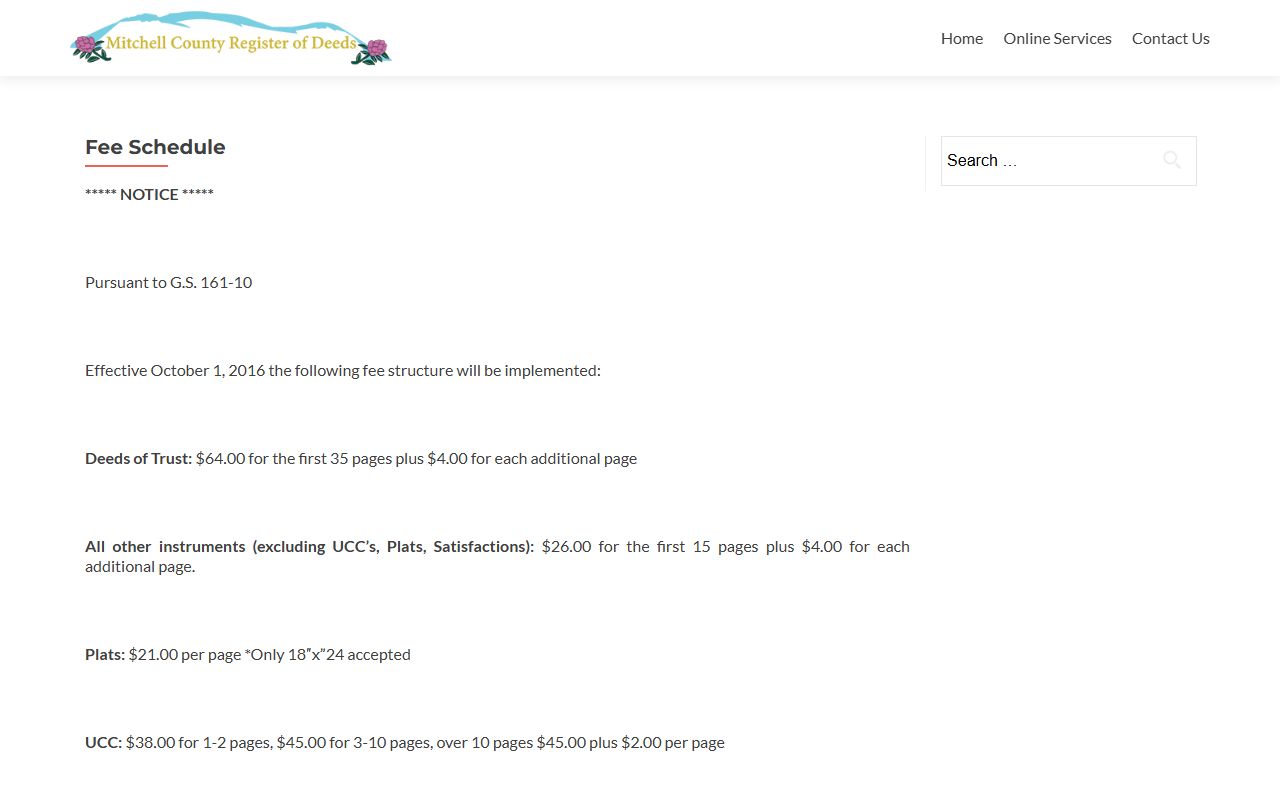
That fee source is useful when estate work also involves recorded documents, but it should not be treated as the clerk's probate filing-fee schedule.
What Mitchell County Probate Records Show
Mitchell County probate records may show the estate case number, decedent name, filing date, estate or special proceeding case type, personal representative, will or codicil if admitted, inventory, accountings, notices, clerk orders, letters testamentary, letters of administration, hearings, and closing documents. Some items may be searchable online, while other documents may exist only in the estate file or require a certified copy request from the clerk.
| Field / Item | Typical Visibility |
|---|---|
| Estate case number | Portal or clerk index |
| Decedent name | Portal or clerk index |
| Filing date | Portal or clerk index |
| Case type | Estate or special proceeding entry |
| Personal representative | In the file if appointed |
| Will / codicil | Paper or electronic file if admitted and public |
| Inventory / accountings | File documents, subject to clerk handling |
| Orders / letters | Clerk orders and letters where issued |
| Restrictions | Sensitive identifiers, sealed matters, or protected filings may be restricted |
The decedent's estate procedures screenshot source is the Judicial Branch estate procedures pamphlet.
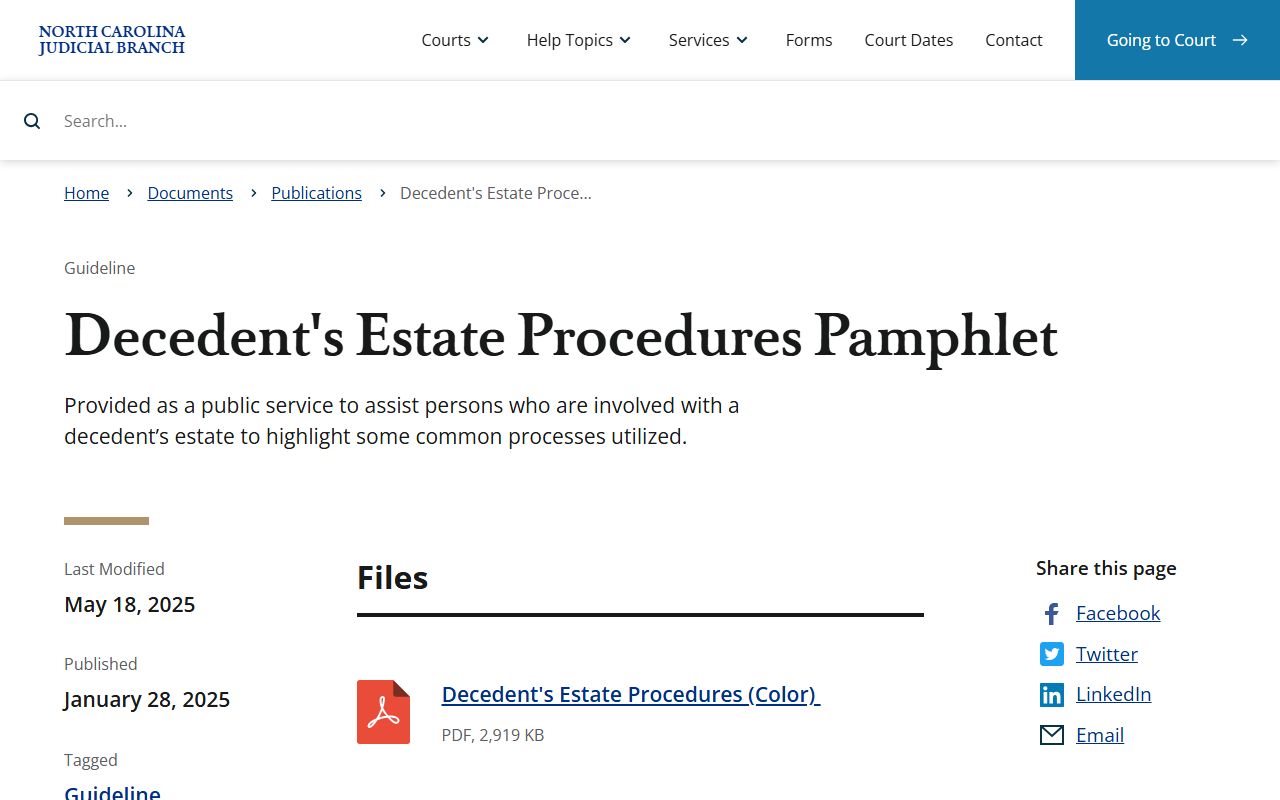
That pamphlet is a statewide estate resource, but it connects directly to Mitchell County because the same clerk probate structure applies locally.
Restricted Mitchell County Probate Records
Probate records are not unlimited public files. The public can usually search basic case information, use clerk terminals, and request paper estate file access, but sensitive identifiers, sealed matters, protected filings, and some guardianship or special proceeding material may be restricted. Portal access and clerk office access are also different. A field that is not visible online may still be available at the courthouse, or it may be restricted by law or court order.
North Carolina public access law gives broad access to public records and clerk-maintained court records, but the same research identifies specific limits for juvenile, sealed, expunged, adoption, mental health, and other protected matters. Probate users should expect redactions of Social Security numbers, financial account numbers, protected addresses, and other private information. When a probate record is needed for legal use, the most reliable source is a clerk-issued certified copy, not an online screen view.
The NCVitals screenshot source is the online vital-record ordering portal.
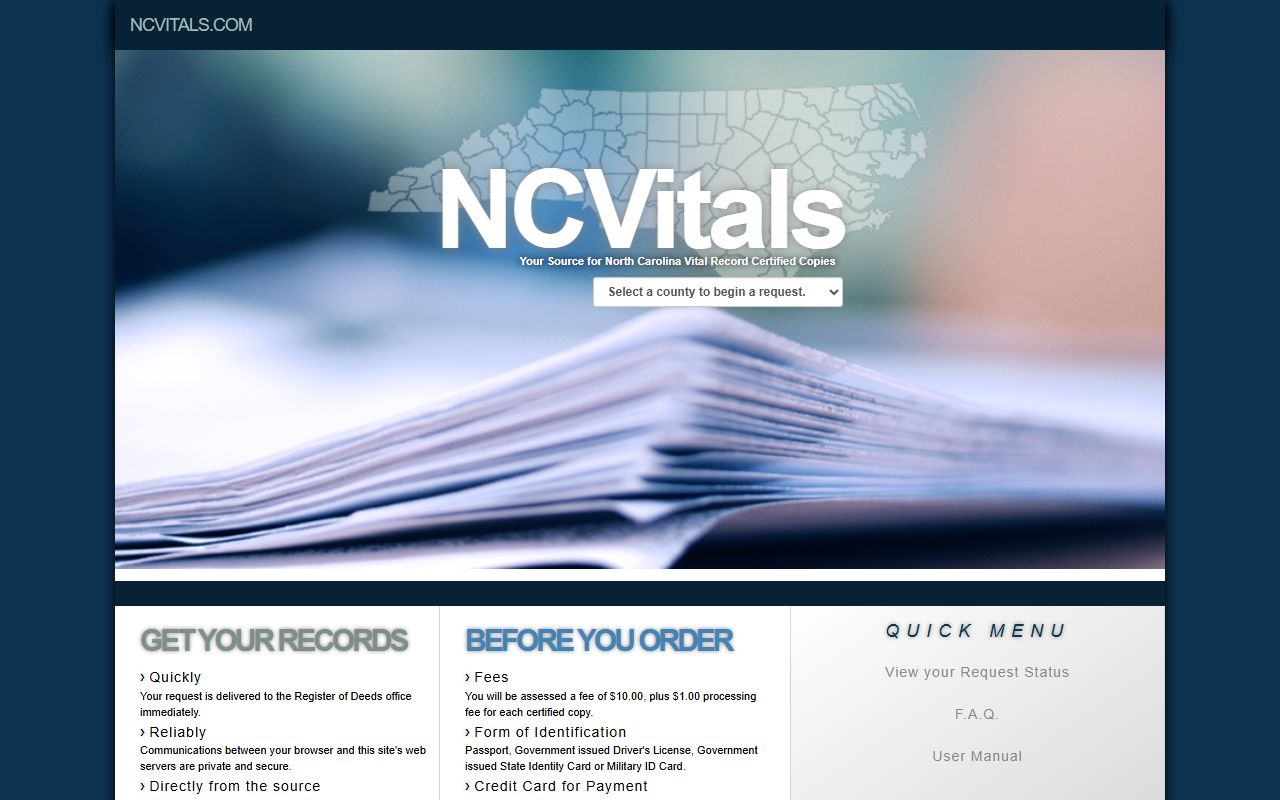
That source is adjacent to probate because estate work often requires death or marriage certificates, but vital-record copies are ordered outside the probate case file.
Note: A death certificate, marriage certificate, and estate file can all relate to one estate, but each record has a different custodian.